
Conscious Living
Nomadic Craftsmanship — Traditions That Survive
Last updated:
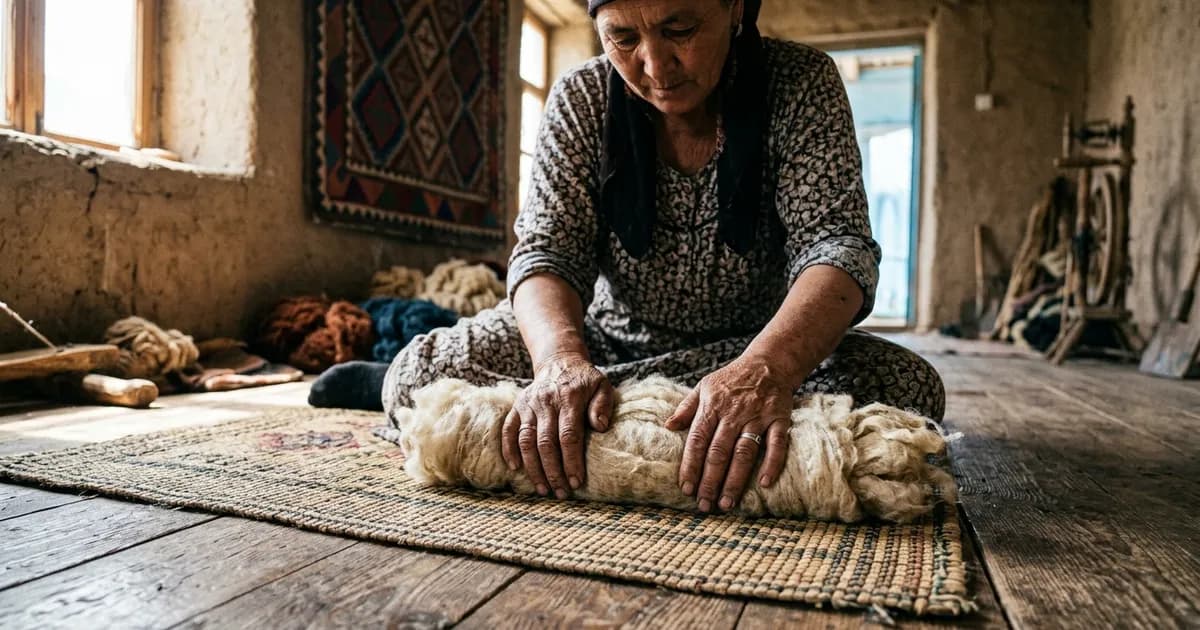
Most traditions die quietly. A last craftsperson who finds no successor. A tool that ends up in a museum. Kyrgyz craftsmanship has chosen a different path.
Today, Gulnara in Naryn felts the same slippers her mother felted — and her grandmother before that. Today, Aida in Bishkek weaves Shyrdak carpets following patterns older than any written record in Central Asia. Today, Nursultan keeps bees in the Suusamyr Valley at 2,500 metres altitude, exactly as his father did — and his father before him.
This is no coincidence. And it is no tourist attraction. It is a choice.
In Brief
Kyrgyz craftsmanship — feltwork (Shyrdak, Ala-Kiyiz), wool processing, and mountain beekeeping — is a living nomadic tradition from Central Asia, not a museum culture. UNESCO recognised Kyrgyz felt-making as intangible cultural heritage (UNESCO 2012, Element No. 00695). Over three million Kyrgyz people still live in cultural continuity with these craft forms today. ULU works directly with named craftswomen — without intermediaries — and brings their work to Europe.
What Is Kyrgyz Craftsmanship — and Why Does It Survive?
Kyrgyzstan lies in the Tian Shan mountains between China, Kazakhstan, and Tajikistan. For millennia, life here was nomadic: families moved with their herds across the high plateaus, from pasture to pasture, from spring to autumn.
From this way of life emerged craft techniques that were not decorative — they were essential for survival. Felt warmed the yurt. Shyrdak carpets covered the floor. Wool became clothing. Honey was both food and medicine.
Today, the nomadic lifestyle has largely disappeared. But the craft techniques have endured — because they are good. Because felt made from mountain sheep wool offers a thermal density that no synthetic material can replicate. Because Shyrdak patterns have an aesthetic logic that works just as well in modern European interiors as on the steppe.
3+ million people in Kyrgyzstan live in cultural continuity with these craft forms, far beyond folklorisation. (Central Asian Cultural Institute, Bishkek 2023)
The craftsmanship does not survive despite modernity. It survives because it is better than many modern alternatives.
From the Hive
Honey knowledge the supermarket skips
Twice a month: varietals, harvest, origin. Plus 10% off your first order.
10% off your first order · No spam. Unsubscribe anytime.
Felt-Making: The Ancient Technique No Loom Can Replace
Of all Kyrgyz craft techniques, felt-making is the oldest and most widespread. There are two main forms:
Ala-Kiyiz — the older technique. Raw wool is laid out on a grass mat, then dampened with water and rolled. Through friction and moisture, the wool fibres felt into a dense sheet. Patterns are created by deliberately working coloured wool tufts into the wool before rolling. The result: a single-toned, textured, soft felt with organic transitions.
Shyrdak — the more complex technique. Two layers of pre-made felt are simultaneously cut according to a stencil pattern and fitted into one another. The contours are outlined with cording and sewn by hand, stitch by stitch. A Shyrdak measuring 200 × 150 cm requires four to six weeks of work.
Neither technique can be industrially replicated. A Jacquard loom can imitate the look — but not the material or the feel. Machine-made "felt" is typically needle-punched, not fulled. It frays. It lacks the density.
UNESCO Recognition: Kyrgyz felt-making (Shyrdak and Ala-Kiyiz) was inscribed on the UNESCO Representative List of the Intangible Cultural Heritage of Humanity in 2012 (Element No. 00695).
Gulnara from Naryn: 40 Years of Felting
Gulnara lives in Naryn — the provincial capital in the heart of Kyrgyzstan, at 2,036 metres altitude. As a child, she sat beside her mother and watched. At twelve, she felted her first slipper. Today she is over fifty, and her hands move with a speed that cannot be learned — that can only develop when you felt every day for four decades.
"Every craftswoman has her own signature," says Gulnara. "After a few years, you can recognise whose hands made a slipper."
Her slippers go to ULU. Without intermediaries.
Shyrdak: When Patterns Are Older Than Writing
Aida works in a workshop in Bishkek. She learned Shyrdak weaving from her mother, who learned it from her mother. The pattern library she works with — sweeping animal horns, stylised water swirls, geometric narrative forms — is part of an oral tradition that has no written version.
The patterns have names. "Kochkor Muiuz" — ram's horn. "Oi" — moon. "Suusamyr" — named after the famous valley. Each pattern carries a meaning that Aida knows and that exists in no book.
Shyrdak carpets cannot be replicated by machine: the two-layer inlaying and hand-stitching of both felt layers is a motor process that knows no automation. (Craft Institute Bishkek, Documentation 2021)
A modern Shyrdak carpet by Aida is not a souvenir. It is a design object that is simultaneously a vessel for a millennia-old tradition. It works just as well in Munich living rooms as in Bishkek exhibition spaces.
Learn more about Shyrdak carpets and their symbolism: → Shyrdak Carpet: History, Patterns, and Meaning
Wool Processing: From the Highlands to the World
Kyrgyz sheep wool is one of the finest raw wools in Central Asia. The sheep graze on highland pastures between 2,500 and 3,500 metres — no particulate pollution, no pesticides, no concentrated feed. The wool is dense, long-stapled, and possesses a natural crimp (waviness) that gives it its felting ability and thermal density.
The processing begins in spring with shearing. The wool is washed, dried, carded (detangled), and then either spun into yarn or processed directly into felt.
For Gulnara's slippers, only the inner wool layer is used — the soft undercoat that lies directly against the sheep's skin. The coarser outer wool is used for carpet underlays or packaging materials. This knowledge of which wool quality suits which purpose is passed down orally.
| Wool Layer | Property | Use |
|---|---|---|
| Inner coat (fine) | Soft, dense, long-stapled | Slippers, scarves |
| Outer coat (coarse) | Sturdy, robust, weatherproof | Carpet underlays, yurt felt |
| Mixed fleece | Versatile | Shyrdak layers, Ala-Kiyiz |
The Beekeeping Tradition of the Suusamyr Valley
The Suusamyr Valley sits at 2,500 metres elevation in the Tian Shan mountains, northwest of Bishkek. It is one of the last great highland valleys of Central Asia where sainfoin (Onobrychis viciifolia) grows in extensive wild stands.
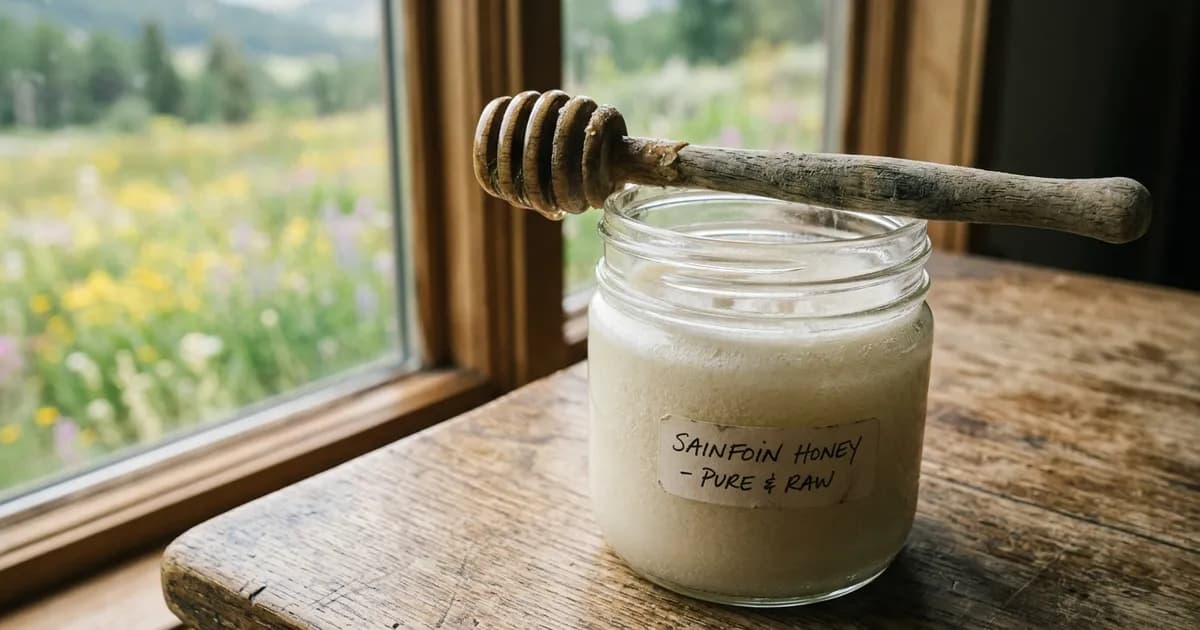
Sainfoin is a leguminous plant with an unusual property: its nectar contains an exceptionally high proportion of sucrose, little fructose, and almost no water. Honey made from sainfoin nectar crystallises quickly and completely — it turns white and creamy, firm like butter.
Nursultan keeps bees in the Suusamyr Valley at an altitude where temperatures can drop below zero at night, even in July. His bees know no pesticides — not because of a certification, but because there is no conventional agriculture at this elevation. The valley is simply too inhospitable for anything other than wild plants and grazing animals.
Suusamyr sainfoin honey from this elevation (2,500 m) shows complete crystallisation within four to six weeks after harvest — a reliable quality indicator for pure sainfoin honey without additives. (Observation Nursultan Apiaries, 2024)
The valley's beekeeping tradition goes back at least four generations. Nursultan's father kept bees, his grandfather kept bees. Transhumance beekeeping — moving colonies to different altitudes depending on the flowering season — is a technique that no app and no textbook can replace. It requires an intimate knowledge of the valley, its rhythm, its weather caprices.
More about beekeeping in Kyrgyzstan and the Suusamyr Valley: → Beekeeping in Kyrgyzstan — How Nursultan Keeps Bees at 2,500 m
How UNESCO Recognition Helps — and What It Does Not
In 2012, UNESCO inscribed Kyrgyz felt-making on the Representative List of the Intangible Cultural Heritage of Humanity (Element No. 00695, extended 2022). This is a significant recognition — but what does it mean in concrete terms?
The UNESCO listing does not protect against economic displacement pressure. It does not increase margins. It does not guarantee successors. What it does: it creates international visibility, opens funding channels, and — importantly — it gives Kyrgyz craftswomen a legitimate confidence in the value of their work.
"Before the UNESCO recognition came, many of my peers thought felt-making was poverty — an occupation for older women without alternatives," says a craftswoman from Naryn. "Afterwards we realised: what we can do, nobody else can."
That is the difference between a craft that survives and one that dies. Not state subsidies. Not museum projects. But the awareness that one's own work is something the world needs.
How ULU Trades Directly — and Why It Matters
The Kyrgyz craft sector struggles with a structural problem: intermediaries, tourist shops, and exporters capture the largest share of value creation. A Shyrdak craftswoman earns less than 30 euros per carpet that sells for 150 euros at a tourist market in Bishkek.
ULU pays directly — not a market price, but the price justified by the craftswoman's time and skill. Gulnara and Aida know who buys their products. They know which country their work ends up in. This is not philanthropy. This is a business model.
For the buyer in Munich or Hamburg, this means: not "handmade in Kyrgyzstan" as a label. But: by Gulnara, from Naryn, at 2,036 metres, by a woman who has been felting for 40 years.
That is the difference between a product and an object with a story.
Browse our selection from Kyrgyzstan: → Gifts from Kyrgyzstan — Handmade, Named, Direct
Caring for Kyrgyz Crafts — Practical Tips
Handmade felt products from Kyrgyz mountain wool are more durable than their reputation suggests. They need no chemicals, no specialist cleaning, and no elaborate care — but they react sensitively to improper treatment.
Basic rules for felt products:
- Hand wash in lukewarm water (max. 30°C), no wringing
- Sheep wool rinse or pH-neutral wool detergent
- Lay flat to dry, not on radiators
- For light matting: special brush, gentle strokes
For detailed care instructions: → How to Wash and Care for Felt Slippers — Step by Step
Frequently Asked Questions About Kyrgyz Crafts
What is Kyrgyz craftsmanship?
Kyrgyz craftsmanship encompasses traditional craft techniques from Kyrgyzstan — above all felt work (Shyrdak carpets and Ala-Kiyiz felt), the processing of highland sheep wool into textiles and slippers, and mountain beekeeping. These techniques originate in the nomadic way of life of the Kyrgyz people and are still passed down within families today.
Why is Kyrgyz craftsmanship UNESCO heritage?
Kyrgyz felt-making was inscribed by UNESCO on the Representative List of the Intangible Cultural Heritage of Humanity in 2012 (extended 2022, Element No. 00695) because it is a living craft form passed from generation to generation, inseparably linked to the nomadic culture of Central Asia, and carries unique collective knowledge.
What is the difference between Shyrdak and Ala-Kiyiz?
Shyrdak is created by cutting and inlaying two pre-made felt layers following a template pattern — an extremely labour-intensive process with razor-sharp contours. Ala-Kiyiz is the older technique: raw wool is felted directly, with coloured wool flakes worked in to create organic, softer patterns. Shyrdak is considered more prestigious, Ala-Kiyiz more primal.
Where in Kyrgyzstan are the best craft products made?
Felt products from the Naryn region (central highlands) are considered high quality because the mountain wool quality there is particularly good. Shyrdak workshops are concentrated around Bishkek and in the Issyk-Kul region. Sainfoin honey comes from the high valleys of the Tian Shan, such as the Suusamyr Valley (approx. 2,500 m), where sainfoin grows in wild stands.
How can I recognise authentic Kyrgyz craftsmanship?
You can recognise authentic Kyrgyz felt craft by: irregularities in density and contour (no industrial felt is uniform), by the feel (fulled wool is more compact and softer than needle-felted), and ideally by the naming of the craftswoman and place of origin. Kyrgyz sainfoin honey crystallises completely and turns creamy white — liquid "Kyrgyz honey" is either not pure or has been heated.
Which nomadic traditions live on in Kyrgyz craft?
The shyrdak pattern repertoire contains symbols from pre-literate oral tradition: animal horn motifs, water spirals, astronomical signs. Transhumant beekeeping — colonies are moved to different altitudes depending on the flowering season — follows an annual rhythm that has not been written down for generations. The choice of wool quality for different products is orally transmitted knowledge. These forms of tacit knowledge are the real heritage.
Tradition is not a trend
Gulnara is not getting younger. Aida has a daughter who has not yet made a decision. Nursultan has two sons, one of whom keeps bees and one who does not.
That is the honest situation. No drama, no false promises. Craft does not survive through assurances, but through demand. Through fair prices. Through people in Munich who know that behind their slipper stands a woman in Naryn.
Kyrgyz craft survives because it is better than the alternatives. Because a felted slipper by Gulnara sits differently on the floor than anything a machine can produce at this price point. Because a shyrdak rug by Aida lasts thirty years if cared for.
That is not romanticism. That is materials science.
ULU — handmade, named, direct. Felt and shyrdak come from named craftswomen in Kyrgyzstan — no middlemen.
Share
Kyrgyz feltmaking (Shyrdak and Ala-Kiyiz) was inscribed on the UNESCO Representative List of the Intangible Cultural Heritage of Humanity in 2012 — element no. 00695, extended 2022.
Over 3 million people in Kyrgyzstan live in cultural continuity with nomadic craft forms — far beyond folklorisation.
A Shyrdak carpet of 200 × 150 cm requires four to six weeks of work — the two-layer inlaying and hand-stitching of both felt layers is a motor process that knows no automation.
Suusamyr sainfoin honey from 2,500 m altitude crystallises completely within four to six weeks after harvest — a reliable quality indicator for pure sainfoin honey without additives.
Gulnara from Naryn has been felting for over 40 years — her slippers carry a signature that no other artisan in the valley can replicate.
The Shyrdak pattern repertoire contains symbols from pre-literate oral tradition — animal horn motifs, water spirals, astronomical signs — documented in no book, yet passed from generation to generation.
Frequently Asked Questions
Kyrgyz craftsmanship encompasses traditional craft techniques from Kyrgyzstan — primarily feltwork (Shyrdak carpets and Ala-Kiyiz felt), the processing of highland sheep wool into textiles and slippers, and mountain beekeeping. These techniques originate in the nomadic way of life of the Kyrgyz people and are still passed down within families today.
Kyrgyz feltmaking was inscribed on the UNESCO Representative List of the Intangible Cultural Heritage of Humanity in 2012 (extended 2022, element no. 00695) because it is a living craft form passed from generation to generation, inseparably linked to the nomadic culture of Central Asia and carrying unique collective knowledge.
Shyrdak is made by cutting and inlaying two pre-made felt layers following a template pattern — an extremely labour-intensive process with razor-sharp contours. Ala-Kiyiz is the older technique: raw wool is felted directly, with coloured wool flocks worked in to create organic, softer patterns. Shyrdak is considered more prestigious, Ala-Kiyiz more original.
Felt products from the Naryn region (central highlands) are considered high quality because the mountain wool there is particularly good. Shyrdak workshops are concentrated around Bishkek and in the Issyk-Kul region. Sainfoin honey comes from the high valleys of the Tian Shan, such as the Suusamyr Valley (approx. 2,500 m), where sainfoin grows wild.
Authentic Kyrgyz feltwork can be recognised by irregularities in density and contour (no industrial felt is uniform), by touch (fulled wool is more compact and softer than needle-felted), and ideally by the naming of the artisan and place of origin. Kyrgyz sainfoin honey crystallises completely and turns creamy white — liquid 'Kyrgyz honey' is either not pure or has been heated.
The Shyrdak pattern repertoire contains symbols from pre-literate oral tradition: animal horn motifs, water spirals, astronomical signs. Transhumant beekeeping follows an annual rhythm that has never been written down across generations. The selection of wool quality for different products is orally transmitted knowledge. These forms of tacit knowledge are the true heritage.

Jamilia
Autorin, ULU Magazin
Jamilia schreibt über kirgisisches Handwerk, Honig und die Geschichten hinter den Produkten. Aufgewachsen in Zentralasien, lebt sie zwischen Bischkek und Berlin.
Related Articles

Conscious Living
Honey and Gut Health: What Current Research Actually Shows
Research into honey and gut health is growing rapidly — but the headlines often outrun the actual findings. Here is what the studies say, and what they do not.
Conscious Living
Honey Antioxidants: What the Research Actually Says
Gallic acid . Taxifolin . What these numbers mean — and what they do not promise.
Conscious Living
Wool Scarf Origin Kyrgyzstan — Tradition Meets Design
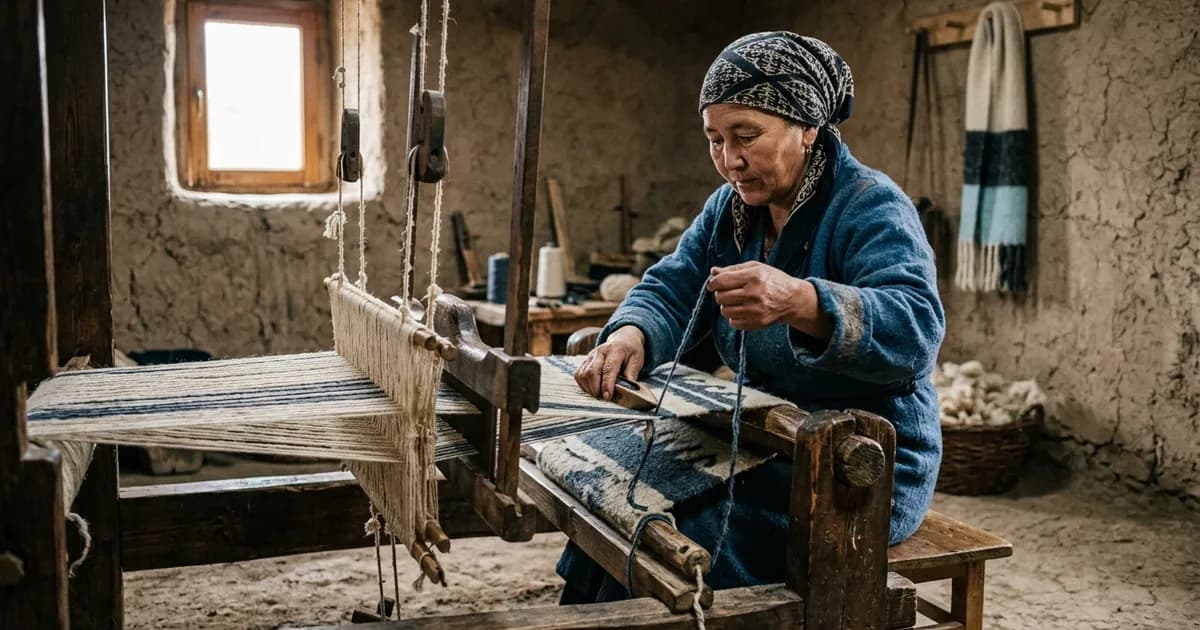
Kyrgyz highland wool for ULU wool scarves comes from sheep grazing between 2,000 and 3,500 metres in the Tian Shan mountains. The extreme temperature swing of up to 70 °C forces an exceptionally dense, lanolin-rich fibre structure. The wool is hand-shorn, dyed with natural colours, and processed using orally transmitted weaving techniques — by named artisans without intermediaries. Kyrgyz felt-making has been on the UNESCO Intangible Cultural Heritage list since 2012 (entry 00695).
From the Hive
Honey knowledge the supermarket skips
Twice a month: varietals, harvest, origin. Plus 10% off your first order.
10% off your first order · No spam. Unsubscribe anytime.