
Conscious Living
Shyrdak vs. Machine-Made Felt Rug — Craft Meets Industry
Last updated:
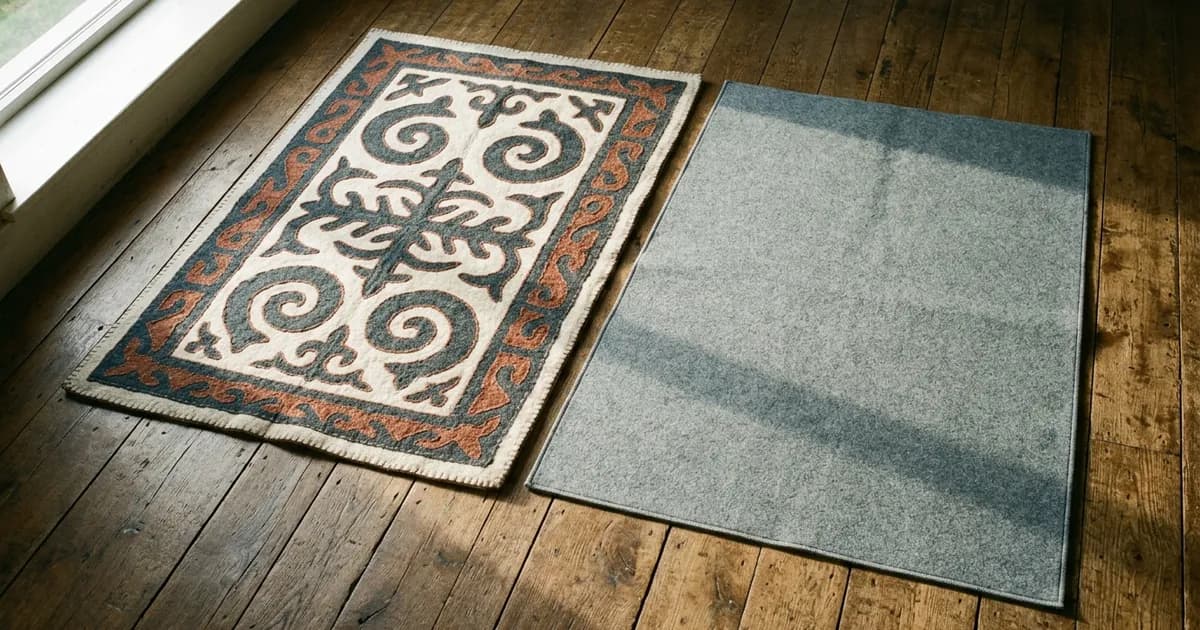
A machine-made felt rug is not a bad choice. That is the first honest sentence of this article. Anyone searching for "shyrdak vs felt rug" deserves no propaganda — they deserve a basis for decision-making.
Here it is.
In Brief
A shyrdak is a handcrafted Kyrgyz felt rug made using mosaic technique from natural sheep wool fibers and plant-based dyes, listed as UNESCO Intangible Cultural Heritage since 2012 (entry 00693). A machine-made felt rug is an industrially manufactured product made from needle felt or wet felt, often from a blend of wool, polyester, or recycled fibers — consistent, affordable, immediately available. Both cover floors. Only one of them has a story.
Quick Comparison: Shyrdak vs. Machine-Made Felt Rug
| Criterion | Shyrdak (handcrafted) | Machine-made felt rug |
|---|---|---|
| Production | Mosaic inlay method, entirely by hand | Needle felt or wet felt machine, industrial |
| Material | 100% sheep wool, Kyrgyz highland sheep | Wool, polyester blend, or recycled fibers |
| Colors | Natural plant-based dyes (onion skins, walnut, pomegranate) | Synthetic dyes, standard industrial palette |
| Lifespan | 50+ years with proper care | 5–15 years depending on quality |
| Uniqueness | Every piece one of a kind — handwork visible | Mass production, identical copies |
| Price (2 m²) | From approx. €200–400+ (direct trade) | From approx. €20–80 (mass market) |
| Care | Gentle vacuuming, 30°C hand wash if needed | Machine washable up to 40°C depending on type |
| Environmental footprint | Short supply chain, no synthetic fibers | Global supply chain, often contains plastic fibers |
| Origin | Naryn/Issyk-Kul, Kyrgyzstan — craftswoman Aida | Factory (CN, TR, DE, IN depending on brand) |
| UNESCO status | Entry 00693 — Intangible Cultural Heritage since 2012 | None |
From the Hive
Honey knowledge the supermarket skips
Twice a month: varietals, harvest, origin. Plus 10% off your first order.
10% off your first order · No spam. Unsubscribe anytime.
What Is Actually the Difference in Production?
This is the core point. Most consumers know what "handmade" means — but do they know what exactly happens by hand with a shyrdak?
Machine-made felt rug: Raw fibers are mechanically felted through needles or hot wet-felting processes. A machine produces several square meters within minutes. The result is uniform, durable, and repeatable. Good for hallways, kitchens, trade fair floors. OTTO lists machine-made felt rugs from approx. €8 per square meter.
Shyrdak: Here, production begins with shearing the sheep in spring. The wool is washed, felted by hand, dyed with plant materials — this process alone takes weeks. Then comes the actual shyrdak technique: Two colored felt layers are placed on top of each other. A pattern is drawn onto the felt with chalk. Both layers are cut simultaneously with a knife. The positive form of one layer is inserted into the negative form of the other — like a puzzle. No material is wasted. Everything fits together. The fragments are sewn together with jeek, a quilted wool band.
This means: A shyrdak measuring 120×180 cm takes several weeks. A 2×3-meter shyrdak can take up to a year (UNESCO nomination documentation, 2012).
Machine-made felt rug: Minutes. Shyrdak: Months to decades.
Where Does the Material Come From — and Does It Matter?
With machine-made felt rugs, material is a deliberate cost calculation. High-end variants (such as from Monofaktur or Hay) use pure virgin wool. Cheaper variants blend in polyester fibers or use recycled materials. Connox and OTTO offer felt rugs from approx. €20 — at that price, pure new wool is hard to imagine.
Shyrdaks traditionally consist of 100% wool from Kyrgyz mountain sheep that graze at altitudes between 1,500 and 3,000 meters. This wool is denser and more robust than lowland wool — because the sheep need it to survive. It is not "better" because it carries a label. It is more robust because the conditions demand it.
The colors are plant dyes: onion skins for yellow and orange, walnut shells for brown and black, pomegranate rind for red tones. No synthetic additives, no industrial dye. This means: shyrdak colors may darken slightly over the decades — not as a flaw, but as a sign of genuine material.
"Kyrgyz highland wool from sheep above 1,500 m altitude has a fiber structure shaped by extreme temperature fluctuations — denser, more robust, longer-lasting than many lowland variants." — ULU Product Analysis, 2026
How Long Do Both Rugs Last?
This is the strongest point of differentiation — and it is factually verifiable.
A machine-made felt rug of pure wool lasts approximately 10–15 years with careful use. Cheaper blended-fiber rugs become thin after 5–8 years, lose their shape, and break down structurally.
A high-quality shyrdak, carefully maintained, can last over 50 years according to UNESCO monitoring. There are documented shyrdaks from the early 20th century still in use in Kyrgyz households today. This is due to the dense, multiply compressed felt structure: two layers cut into each other and sewn together are mechanically more stable than a single-layer machine surface.
Do the math: A shyrdak for €300 over 50 years = €6 per year. A machine-made rug for €60 over 10 years = €6 per year. Same cost — but after 50 years, your grandchild still has the shyrdak.
50-year lifespan of the shyrdak vs. 10–15 years of a high-quality machine-made felt rug (UNESCO, 2012).
UNESCO Cultural Heritage — What Does That Actually Mean?
In December 2012, the Art of Kyrgyz Traditional Felt Carpets Ala-Kiyiz and Shyrdak was inscribed on the UNESCO Representative List of the Intangible Cultural Heritage of Humanity (entry 00693). The committee classified the tradition as "in urgent need of safeguarding" — not because the shyrdak is unpopular, but because the knowledge dies if it is not passed on.
In 2019, the province of Naryn in Kyrgyzstan received the title World Craft City for Felt Carpets from the World Crafts Council — an international distinction that established Naryn as a global center of this craft.
Aida, one of the craftswomen near Bishkek with whom ULU works directly, learned the shyrdak craft from her mother, who learned it from her mother. The patterns she cuts are the same ones that have adorned Kyrgyz yurts for centuries. No sketch, no template — memory and hand.
A machine-made felt rug has no such story. That is not a criticism. It is a difference that some count — and some do not.
When Is the Machine-Made Felt Rug the Better Choice?
Honesty also means: there are cases where a machine-made carpet is the more sensible choice.
Choose a machine-made felt carpet when:
- You have a temporary living arrangement (rental apartment, transitional period)
- You want to furnish a children's room or pet-frequented room that sees heavy wear
- You want to cover a larger area (e.g. office, hallway) cost-effectively
- You prefer standardised furnishing without stories — not everyone wants one
- You need immediate availability: online retailers like OTTO, Connox or ruugs.de deliver within a few days
Machine-made doesn't mean bad. It means: different relationship, different value.
When is the Shyrdak the better choice?
Choose a Shyrdak when:
- You know you're staying long — and you want your floor to do the same
- You want a piece that defines the room, not just occupies it
- Origin transparency matters to you — you want to know the person's name, not just the standard
- You're investing in interior living, not just furnishing
- You're looking for an extraordinary gift that lasts decades
Shyrdaks in modern colour palettes — anthracite and cream, ice blue and sand, moss green and white — fit into Bauhaus-inspired interiors just as well as traditional country house style. The traditional symbols (Kochkor muiuzu = ram's horns, Kuş kanaty = bird's wings) remain — the colour design adapts.
Care comparison
Both are low-maintenance. The difference lies in the details.
| Care step | Shyrdak | Machine-made felt carpet |
|---|---|---|
| Vacuuming | Weekly, low setting, in fibre direction | Weekly, medium setting |
| Stains | Blot immediately, lukewarm water + wool detergent | Depends on manufacturer: blot cold, possibly use stain remover |
| Washing | Hand wash / gentle cycle max. 30°C, dry flat | Often machine washable at 40°C (manufacturer-dependent) |
| Tumble dryer | Never | Manufacturer-dependent (often No) |
| Spin cycle | Never | Manufacturer-dependent |
| Storage | Rolled up, dry, protected from light | Folded or rolled |
Environmental footprint: Short supply chain vs. global production
No greenwashing here. Just facts.
A machine-made felt carpet made from polyester or blended fibres contributes to microplastic pollution at the end of its life — through washing, through abrasion. A pure wool felt carpet is biodegradable. The supply chain of a machine-made carpet from Asian production often spans multiple continents.
A Shyrdak from Aida in the region near Bishkek: wool from local sheep, natural dyes from local plants, one craftswoman, one product. The supply chain is short. The transparency is maximum.
That doesn't mean every Shyrdak is automatically "sustainable" — a word deliberately absent from this article. It means: the origin is traceable. The materials are known. The product decomposes at the end without residue.
Where can you buy a genuine Shyrdak in Germany?
The German market now offers several sources. Shyrdak-jurte.de, shyrdakjurte.com and swiss-shyrdak.ch are established retailers with Kyrgyz products. Etsy.de offers individual pieces from various producers.
At ULU, we work directly with Aida — a craftswoman in the region near Bishkek who learned the Shyrdak from her mother. No middlemen. We know who made the carpet, from which wool, with which dyes.
That's not a certificate. That's a direct relationship.
Buy Shyrdak carpets — current collection
Or if you'd like to learn more about the Shyrdak as an object before you buy: What is a Shyrdak? UNESCO heritage & craftsmanship
Frequently asked questions
What is the difference between a Shyrdak and a felt carpet?
A Shyrdak is a specific form of felt carpet from Kyrgyzstan, handmade using mosaic inlay technique. Two coloured felt layers are cut into each other and sewn together. A machine-made felt carpet, by contrast, is industrially manufactured through needle felting or wet felting processes, often from blended fibres. The Shyrdak has been on the UNESCO Intangible Cultural Heritage list since 2012 (entry 00693) — a status no machine-made product holds.
How long does a Shyrdak last compared to a machine-made felt carpet?
A high-quality Shyrdak can last 50 years or longer with careful care (UNESCO Monitoring, 2012). A machine-made felt carpet of pure wool typically lasts 10–15 years, cheaper blended fibre variants 5–8 years. Calculated over its lifespan, a Shyrdak is often more cost-effective despite its higher purchase price.
How much does a Shyrdak cost compared to a machine-made felt carpet?
Machine-made felt carpets are available from approx. €20–80 for a standard size (OTTO, Connox, ruugs.de). A handmade Shyrdak starts at approx. €200–400+ depending on size and complexity, traded directly from the producer. The higher price is explained by weeks to months of handwork, natural materials and the direct supply chain without middlemen.
Is a Shyrdak really handmade?
Yes — completely. Every step of Shyrdak production is done by hand: shearing the sheep, washing the wool, wet felting, dyeing with plant-based substances, cutting in mosaic technique and sewing. There is no Shyrdak machine. The maker Aida, with whom ULU works, produces each piece as a one-of-a-kind in the region near Bishkek.
Can machine-made felt carpets be washed more easily than Shyrdaks?
Machine-made felt carpets from blended fibres are often designed for machine washing up to 40°C. Shyrdaks made from pure natural wool can only tolerate hand washing or gentle cycle at max. 30°C and must be dried flat — no tumble dryer, no spin cycle. However, due to their dense felt structure and natural dirt repellence, Shyrdaks need to be washed far less frequently.
Why is the Shyrdak UNESCO Cultural Heritage?
UNESCO recognised the Art of Kyrgyz traditional felt carpets Ala-Kiyiz and Shyrdak as Intangible Cultural Heritage in 2012 because the knowledge of this technique is passed down in direct line from mother to daughter and is threatened by urbanisation and industrial competition. Entry 00693 classifies the tradition as "in urgent need of safeguarding" — a sign that active support is necessary to prevent the craft from dying out.
A carpet covers a floor. A Shyrdak defines it.
Internal Links:
- Buy Shyrdak — current collection
- What is a Shyrdak? UNESCO heritage & craftsmanship
- Gifts from Kyrgyzstan — meaning and selection
- Handmade felt ballerinas from Naryn
Sources:
- UNESCO Intangible Cultural Heritage, Entry 00693 (2012): Ala-kiyiz and Shyrdak, art of Kyrgyz traditional felt carpets
- UNESCO Monitoring Report: Preservation and Promotion of Traditional Kyrgyz Felt Carpets (2022)
- World Crafts Council: Naryn Province — World Craft City for Felt Carpets (2019)
- OTTO.de: Buy felt carpets online (price reference, 2026)
- shyrdak-jurte.de (2026)
- shyrdakjurte.com (2026)
Share
A shyrdak measuring 2×3 metres can require up to a year of handwork — from shearing the sheep in spring to sewing on the border strips in winter.
UNESCO recognised the art of Kyrgyz traditional felt rugs Ala-Kiyiz and Shyrdak as Intangible Cultural Heritage in December 2012 — classified as 'in urgent need of safeguarding' (entry 00693).
In 2019, Naryn Province in Kyrgyzstan was awarded the title World Craft City for felt rugs by the World Crafts Council — an international recognition as a global centre of felt art.
Machine-made felt rugs from blended fibres are available on the German market from around €8 per square metre; a handcrafted shyrdak from direct trade starts at around €200–400+ depending on size.
A high-quality shyrdak, carefully maintained, can last over 50 years according to UNESCO monitoring — compared to 10–15 years for a good machine-made wool felt rug.
Naryn Province, the centre of shyrdak production, sits at an average altitude of 2,000 metres — the wool of the sheep kept there has a fibre structure shaped by extreme temperature fluctuations.
Frequently Asked Questions
A shyrdak is a specific type of felt rug from Kyrgyzstan, handcrafted using mosaic inlay technique. Two coloured layers of felt are cut into interlocking shapes and sewn together. A machine-made felt rug is industrially produced through needle-felting or wet-felting processes, often from blended fibres. The shyrdak has been on the UNESCO Intangible Cultural Heritage list since 2012 (entry 00693) — a status no machine-made product holds.
A high-quality shyrdak can last 50 years or longer with proper care (UNESCO Monitoring, 2022). A machine-made felt rug in pure wool typically lasts 10–15 years, while cheaper blended-fibre versions last 5–8 years. Calculated over its lifespan, a shyrdak is often more cost-effective despite its higher purchase price.
Machine-made felt rugs start at around €20–80 for a standard size (OTTO, Connox). A handcrafted shyrdak starts at around €200–400+, depending on size and complexity, when traded directly from the producer. The higher price reflects weeks to months of handwork, natural materials and a direct supply chain without intermediaries.
Yes — entirely. Every step of shyrdak production is done by hand: shearing the sheep, washing the wool, wet-felting, dyeing with plant-based substances, cutting in mosaic technique and sewing. There is no shyrdak machine. The craftswoman Aida, with whom ULU collaborates, produces every piece as a one-off in the region near Bishkek, Kyrgyzstan.
Machine-made felt rugs from blended fibres are often designed for machine washing up to 40°C. Shyrdaks made from pure natural wool can only tolerate hand washing or a gentle cycle at max 30°C and must be dried flat. However, thanks to their dense felt structure and natural soil resistance, shyrdaks need washing far less frequently.
UNESCO recognised the art of Kyrgyz traditional felt rugs Ala-Kiyiz and Shyrdak as Intangible Cultural Heritage in 2012 because the knowledge of this technique is passed down directly from mother to daughter and is threatened by urbanisation and industrial competition. Entry 00693 classifies the tradition as 'in urgent need of safeguarding'.

Jamilia
Autorin, ULU Magazin
Jamilia schreibt über kirgisisches Handwerk, Honig und die Geschichten hinter den Produkten. Aufgewachsen in Zentralasien, lebt sie zwischen Bischkek und Berlin.
Related Articles

Conscious Living
Honey and Gut Health: What Current Research Actually Shows
Research into honey and gut health is growing rapidly — but the headlines often outrun the actual findings. Here is what the studies say, and what they do not.
Conscious Living
Honey Antioxidants: What the Research Actually Says
Gallic acid . Taxifolin . What these numbers mean — and what they do not promise.
Conscious Living
Wool Scarf Origin Kyrgyzstan — Tradition Meets Design
Kyrgyz highland wool for ULU wool scarves comes from sheep grazing between 2,000 and 3,500 metres in the Tian Shan mountains. The extreme temperature swing of up to 70 °C forces an exceptionally dense, lanolin-rich fibre structure. The wool is hand-shorn, dyed with natural colours, and processed using orally transmitted weaving techniques — by named artisans without intermediaries. Kyrgyz felt-making has been on the UNESCO Intangible Cultural Heritage list since 2012 (entry 00695).
From the Hive
Honey knowledge the supermarket skips
Twice a month: varietals, harvest, origin. Plus 10% off your first order.
10% off your first order · No spam. Unsubscribe anytime.