
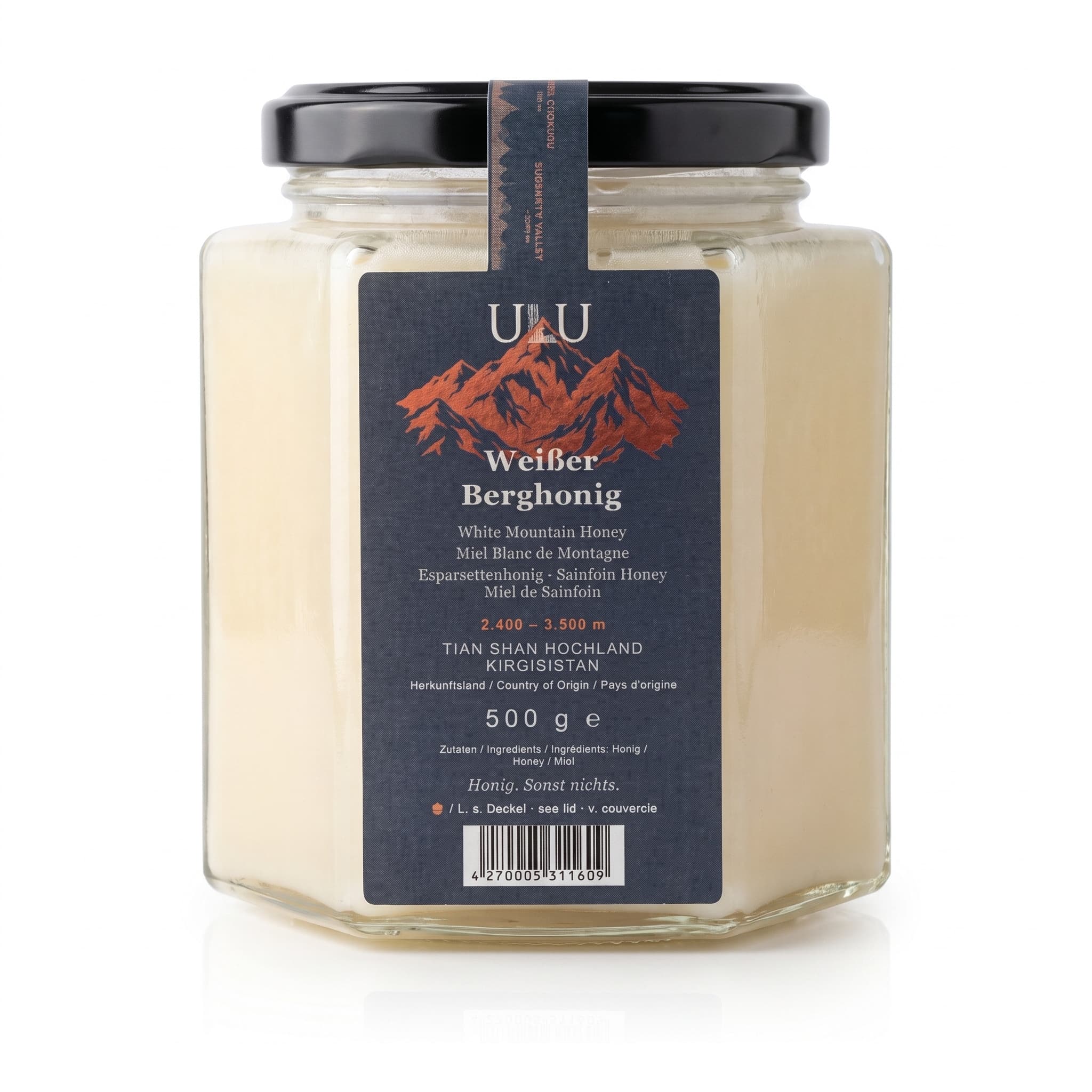
White Sainfoin Honey from Kyrgyzstan
Mountain Honey
What is great does not shout. It endures.
34,90 €
Unit price: €69.80/kgRare white sainfoin honey from the highlands of Kyrgyzstan. Harvested by family beekeepers at 2,400–3,500 m, where wild sainfoin covers the Tian Shan mountain meadows. Creamy white, mild and floral. Not pasteurised, gently processed at a maximum of 40 °C, naturally crystallised. Our beekeeping partner won the Apimondia silver medal in 2019. An alternative to Manuka honey at a fraction of the price.
- Your honey in safe hands
- Securely packed & shipped
- Shipping across Germany
- At your door in 2-4 working days
- Award-winning — Apimondia Silver
Product Details
- Variety
- Sainfoin honey (Onobrychis viciifolia)
- Origin
- Kyrgyzstan — Regions Naryn, Issyk-Kul, Talas
- Altitude
- 2,400–3,500 m a.s.l.
- Texture
- Creamy-firm, naturally crystallised
- Colour
- White to ivory
- Contents
- 500 g (jar)
- Storage
- Cool and dry, protected from light
- Certifications
- Apimondia Silver 2019 (Supplier)
Food information
- Name of the food
- Sainfoin honey
- Ingredients
- Honey
- Net quantity
- 500 g
- Country of origin
- Kyrgyzstan
- Food business operator
- Mante UG (haftungsbeschränkt), An den Eichen, 24248 Mönkeberg, Deutschland
Tasting notes
- Colour and texture
- Creamy white, naturally crystallised
- Palate
- Mild and floral with a delicate caramel note
Origin
- Altitude
- 2,400–3,500 m
- Mountains
- Tian Shan, Kyrgyzstan
- Forage
- Sainfoin (Onobrychis viciifolia)
- Harvest
- Once a year
- Processing
- Gently processed at max. 40 °C, not pasteurised
As a gift: order by Friday, 18.12.2026 for delivery before Christmas. See gift sets
The Story
In the highlands of the Tian Shan, between 2,400 and 3,500 metres, sainfoin blooms — a wild legume that releases its nectar for just a few weeks each year. Family beekeepers keep their bees here. No industrial beekeeping, no supplemental feeding, no blending. The bees collect what the mountains give. This honey is the product of a landscape that still exists as it did centuries ago.