
Conscious Living
Why Does Honey Crystallise White? The Science Behind It
Last updated:
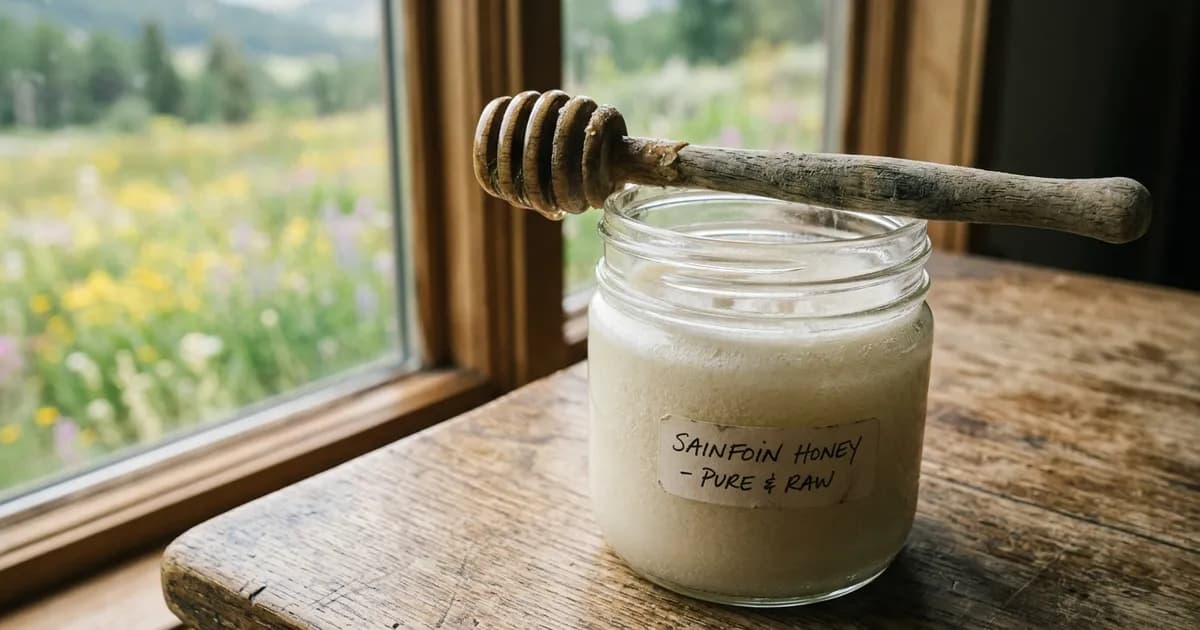
Your honey has suddenly turned white and rock-hard. Mould? Added sugar? Spoiled?
None of the above. What you're seeing is honey crystallisation — one of the surest proofs that you're dealing with real, unprocessed honey. Industrially made honey barely crystallises. Why? Because it was heavily heated and finely filtered until nothing was left that could form crystals.
In this article you'll learn the chemistry behind honey crystallisation, why crystal size determines whether your honey looks white or golden-brown, and how to gently return crystallised honey to a liquid state — without destroying its delicate structure.
In Brief
Honey crystallises because glucose is less water-soluble than fructose and separates out of the solution at room temperature. The finer the crystals, the whiter and creamier the honey looks — an optical phenomenon, not a quality defect. Sainfoin honey from the Tian Shan mountains (2,400–3,500 m) crystallises naturally very fine and develops its characteristic white-creamy texture. According to a study by the University of Salerno, the honey's bioactive constituents remain fully intact with correct storage below 20°C.
What Happens During Honey Crystallisation at the Molecular Level?
Honey is a supersaturated sugar solution. That means: there's simply more sugar dissolved in it than the water can hold stably at normal temperature. Nature resolves this equilibrium problem through crystallisation.
The decisive sugar is glucose (grape sugar). Glucose is considerably less water-soluble than fructose (fruit sugar) and therefore separates out of the solution — in the form of tiny crystal nuclei. Each of these nuclei draws further glucose molecules to itself, and the crystal grows.
The fructose, by contrast, stays liquid. The result: the honey turns solid, but its taste and composition don't change.
Glucose saturation limit: In aqueous solution, glucose dissolves at 20°C to about 90 g/100 ml — honey often contains 280–320 g of total sugar per 100 ml, far more than the water can hold.
From the Hive
Honey knowledge the supermarket skips
Twice a month: varietals, harvest, origin. Plus 10% off your first order.
10% off your first order · No spam. Unsubscribe anytime.
Why Does Crystallised Honey Turn White? The Role of Crystal Size
Here lies the heart of the question — and the answer has nothing to do with purity or additives, but with the physics of light.
Fine crystals scatter light more strongly than coarse ones. The smaller and more even the glucose crystals in your honey, the more white light is reflected off their surface — much like fresh snow compared with old ice.
| Crystal size | Appearance | Texture | Typical honey varieties |
|---|---|---|---|
| Very fine (< 0.05 mm) | White to cream-white | Spreadable, velvety | Sainfoin honey, rapeseed honey |
| Medium (0.05–0.5 mm) | Pale yellow to cloudy | Grainy, firm | Blossom honey, clover honey |
| Coarse (> 0.5 mm) | Amber, grainy | Sandy, hard | Sunflower honey, forest honey |
Crystal fineness (sainfoin honey): Crystals below 0.04 mm — optically white, texturally creamy like butter. (Sainfoin Compound Profile)
Why Does My Honey Crystallise So Fast — or Not at All?
The glucose-to-fructose ratio is the most important factor. Varieties with a high glucose share crystallise fast, varieties with a high fructose share stay liquid for a long time.
| Honey variety | Glucose (%) | Fructose (%) | Crystallisation time |
|---|---|---|---|
| Rapeseed honey | ~35 | ~36 | Days to 2 weeks |
| Sainfoin honey | ~34 | ~41 | 4–8 weeks (very fine) |
| Clover honey | ~31 | ~38 | 4–12 weeks |
| Acacia honey | ~24 | ~42 | Months to never |
| Forest honey | ~27 | ~38 | Very slow |
Two more factors speed up or slow down honey crystallisation:
Temperature: The sweet spot is around 14°C — where honey crystallises fastest. Above 25°C the process slows noticeably. Below 5°C (fridge) it nearly stops.
Crystal nuclei: Every speck of dust, every pollen grain, every tiny air bubble can act as a nucleus from which crystals grow. Heavily filtered honey barely contains these nuclei — it stays liquid longer, but also has fewer pollen traces and less natural complexity.
Is Crystallised Honey Still Good? What the Chemistry Says
Yes — without qualification.
Crystallisation doesn't change the honey's chemical composition. The glucose molecules merely shift their physical state from dissolved to solid. All the other constituents — fructose, water, minerals, polyphenols, volatile aroma compounds — remain unchanged in the honey.
One measurable difference: the water content in the remaining liquid phase rises slightly as glucose crystallises and releases bound water. In rare cases, at storage temperatures above 20°C, that can lead to fermentation — but that's not a problem of crystallisation, it's a problem of the wrong storage temperature.
"Crystallization is a natural physical process that does not alter the chemical composition or nutritional value of honey." (Laves Lower Saxony, honey-crystallisation fact sheet, 2024)
The opposite of a quality statement would be more like this: honey that never crystallises may have been heavily heated or filtered — both reduce aroma variety and can lower the content of heat-sensitive compounds.
Our sainfoin honey contains 60 identified volatile aroma compounds, 71.31% of them terpenoids with hotrienol as the dominant component — an aroma density that is only measurable in unprocessed, non-overheated honey.
How Do You Return Crystallised Honey to Liquid?
The method is simple. The temperature is decisive.
Step by Step: Warming Honey in a Water Bath
- Keep the jar closed — don't open it while the honey is still solid.
- Fill a pot with warm water — target temperature: 35–40°C. No higher.
- Place the jar in the water bath — the water should reach just below the lid.
- Wait 20–40 minutes, stirring occasionally.
- Check the temperature — use a kitchen thermometer. Above 40°C, volatile aroma compounds start to escape.
- Don't boil, don't microwave — microwaves create hotspots of 80–100°C that cause local overheating.
Why max. 40°C?
From about 40°C, enzymatic compounds in the honey begin to denature. Hotrienol and other volatile terpenoids, responsible for the aroma of sainfoin honey, start to evaporate at around 45°C. At 60°C the characteristic aroma density of a natural honey is already clearly reduced.
Our sainfoin honey carries the recommendation of max. 20°C storage temperature, because the fine crystal structure is irreversibly damaged above that limit — the honey loses its creamy texture and can't win it back.
Store it right: Keep sainfoin honey cool and dry at max. 20°C. That preserves the characteristic white-creamy texture. (the cooperative product specification, 2025)
Why Does ULU Sainfoin Honey Crystallise So Fine?
Our Sky Nectar sainfoin honey comes from four regions of the Tian Shan in Kyrgyzstan (Naryn, Issyk-Kul, Talas, Osh), at 2,400–3,500 m altitude. The honey is gently processed at max. 40 °C, not pasteurised.
That has a direct effect on crystallisation:
- Not pasteurised: Honey that is gently processed at max. 40 °C, not pasteurised, keeps its natural crystal nuclei — pollen, wax particles, enzyme traces. These promote even, fine crystallisation.
- Sainfoin as the nectar source: The sainfoin plant (Onobrychis viciifolia) supplies a nectar with a characteristic glucose-fructose relation that favours fine crystallisation.
- A cool climate: Plateaus like Suusamyr have night temperatures of 5–15°C even in summer — natural crystallisation conditions right after the harvest.
The result: a honey that doesn't hide when it turns white. It shows what it is.
More on the origin and constituents of our sainfoin honey in the Sainfoin Honey Guide and on the sainfoin honey product page.
Frequently Asked Questions About Honey Crystallisation
Why does honey turn white when it crystallises?
The white colour comes from light scattering off the fine glucose crystals. Very small, even crystals — like those forming in sainfoin or rapeseed honey — reflect white light off their surface, much like fresh snow. The honey itself doesn't grow lighter or change its composition. The colour is a purely optical effect of crystal size.
Is white crystallised honey still edible?
Yes, completely. Crystallised honey is neither spoiled nor of lesser quality. Crystallisation changes only the physical structure (solid instead of liquid), not the chemical composition. All constituents are preserved. The one condition: the honey was stored correctly at max. 20°C, to avoid fermentation from an increased free-water content.
What do I do when honey has turned solid?
Warm the honey gently in a water bath at 35–40°C. No boiling water, no microwave — both create temperatures that destroy volatile aroma compounds. Place the jar in the warm water bath, wait 20–40 minutes, stir occasionally.
Which honey crystallises fastest?
Rapeseed honey crystallises fastest — often within a few days to two weeks. The reason: a high glucose content (~35%) with a relatively low water share. Sainfoin honey crystallises after 4–8 weeks into a fine, creamy mass. Acacia honey stays liquid for months thanks to its high fructose share (~42%).
Why does supermarket honey barely crystallise?
Industrially bottled honey is pasteurised at 60–80°C and pressed through microfilters to remove pollen and wax particles that act as crystal nuclei. That extends the liquid phase but reduces aroma variety and natural composition. Crystallisation resistance is no mark of quality, but an indicator of processing.
Can I store honey in the fridge?
Technically yes — below 5°C crystallisation almost completely stops. For sainfoin honey, though, refrigeration isn't recommended: the moisture in the fridge can attack the surface, and sharp temperature changes can cause condensation inside the jar. Better: store it dark, dry, at max. 20°C.
Conclusion: Honey Crystallisation as Proof of Authenticity
Water runs from the tap. Real butter turns hard. Natural honey crystallises.
When your honey turns white and solid after a few weeks, that's no surprise — it's a promise it's keeping. A honey that never crystallises either has an unusually high fructose content (like acacia honey), or it was treated in a way that leaves it without natural crystallisation nuclei.
Our sainfoin honey from the Tian Shan crystallises. White, creamy, fine. Gently processed at max. 40 °C, not pasteurised. Just honey.
More on how to store honey correctly so the texture stays stable: Storing honey — the complete guide.
Or straight to the product page: Sky Nectar — white sainfoin honey from Kyrgyzstan.
"Real sweetness is rare."
Share
Sainfoin honey contains 60 identified volatile aroma compounds, 71.31% of them terpenoids — an aroma density measurable only in non-overheated natural honey.
Very fine glucose crystals below 0.04 mm scatter light entirely diffusely — that is why sainfoin honey appears white after crystallisation, not because its composition has changed.
Industrially pasteurised honey is treated at 60–80°C and pressed through microfilters — this removes pollen and wax particles that act as crystal nuclei, making the honey artificially liquid.
Crystallisation does not change the honey's chemical composition — fructose, minerals, polyphenols, and volatile aroma compounds all remain unchanged in the honey.
Frequently Asked Questions
The white colour comes from light scattering off the fine glucose crystals. Very small, even crystals — like those forming in sainfoin or rapeseed honey — reflect white light off their surface, much like fresh snow. The honey itself changes neither its composition nor its quality. The colour is a purely optical effect of crystal size.
Yes, completely. Crystallised honey is neither spoiled nor of lesser quality. Crystallisation changes only the physical structure (solid instead of liquid), not the chemical composition. The one condition: the honey was stored correctly at max. 20°C, to avoid fermentation from an increased free-water content.
Warm the honey gently in a water bath at 35–40°C. No boiling water, no microwave — both create temperatures that destroy volatile aroma compounds. Place the jar in the warm water bath, wait 20–40 minutes, stir occasionally.
Rapeseed honey crystallises fastest — often within a few days to two weeks. The reason: a high glucose content (~35%) with a relatively low water share. Sainfoin honey crystallises after 4–8 weeks into a fine, creamy mass. Acacia honey stays liquid for months thanks to its high fructose share (~42%).
Industrially bottled honey is pasteurised at 60–80°C and pressed through microfilters to remove pollen and wax particles that act as crystal nuclei. That extends the liquid phase but reduces aroma variety and natural composition. Crystallisation resistance is no mark of quality, but an indicator of processing.
Technically yes — below 5°C crystallisation almost completely stops. For sainfoin honey, though, refrigeration isn't recommended: the moisture in the fridge can attack the surface, and sharp temperature changes can cause condensation inside the jar. Better: store it dark, dry, at max. 20°C.

Jamilia
Autorin, ULU Magazin
Jamilia schreibt über kirgisisches Handwerk, Honig und die Geschichten hinter den Produkten. Aufgewachsen in Zentralasien, lebt sie zwischen Bischkek und Berlin.
Related Articles

Conscious Living
Honey and Gut Health: What Current Research Actually Shows
Research into honey and gut health is growing rapidly — but the headlines often outrun the actual findings. Here is what the studies say, and what they do not.
Conscious Living
Honey Antioxidants: What the Research Actually Says
Gallic acid . Taxifolin . What these numbers mean — and what they do not promise.
Conscious Living
Wool Scarf Origin Kyrgyzstan — Tradition Meets Design
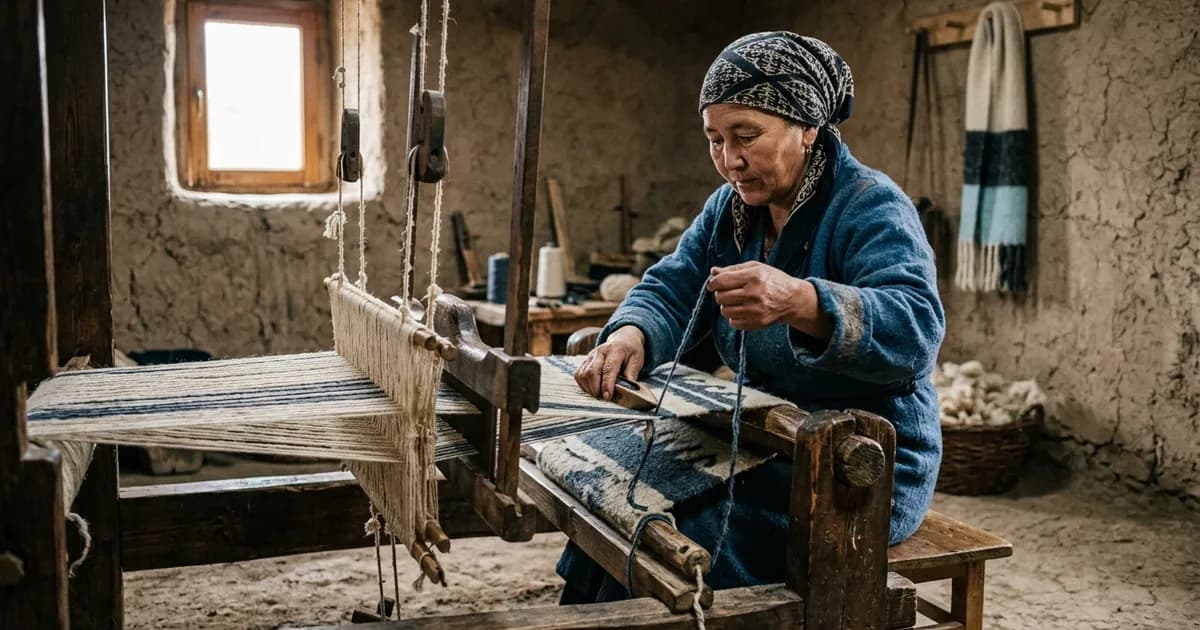
Kyrgyz highland wool for ULU wool scarves comes from sheep grazing between 2,000 and 3,500 metres in the Tian Shan mountains. The extreme temperature swing of up to 70 °C forces an exceptionally dense, lanolin-rich fibre structure. The wool is hand-shorn, dyed with natural colours, and processed using orally transmitted weaving techniques — by named artisans without intermediaries. Kyrgyz felt-making has been on the UNESCO Intangible Cultural Heritage list since 2012 (entry 00695).
From the Hive
Honey knowledge the supermarket skips
Twice a month: varietals, harvest, origin. Plus 10% off your first order.
10% off your first order · No spam. Unsubscribe anytime.