
The Land
3,000 Metres: Why Genuine Mountain Honey Comes from the Tian Shan
Last updated:
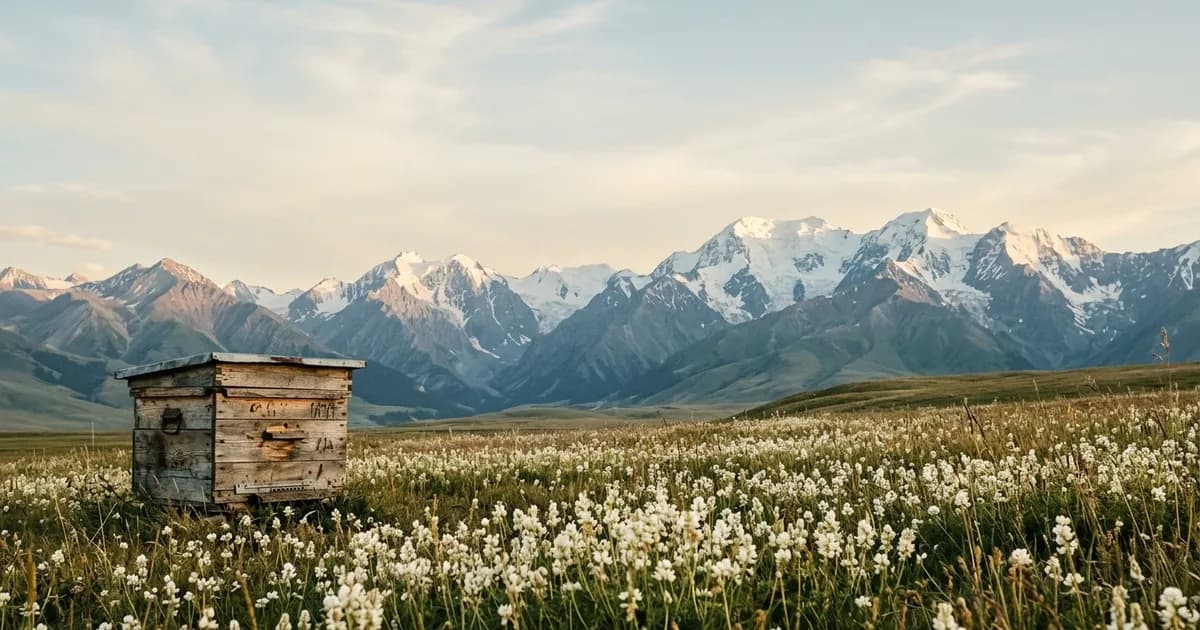
Most honey labelled "mountain honey" comes from valleys at a few hundred metres elevation. Genuine mountain honey from the Tian Shan is something entirely different — and the difference starts at 2,400 metres.
This article explains what separates the Tian Shan from other mountain regions, why altitude matters for honey quality, and why ULU sources exclusively from this specific range.
The Tian Shan: Geography and Context
The Tian Shan — "Heavenly Mountains" in Chinese — is one of the largest mountain systems in Central Asia. The range runs approximately 2,500 kilometres across Kyrgyzstan, Kazakhstan, China, and Tajikistan. The highest peaks exceed 7,000 metres. The valleys and plateau meadows (jailoos) at 2,400–3,500 metres are home to one of the last large, intact alpine ecosystems in the Northern Hemisphere.
What makes the Tian Shan unusual in global context:
Scale of intact alpine meadow: The jailoos of Kyrgyzstan cover millions of hectares of undisturbed mountain grassland. There is no industrial agriculture above 2,000 metres. No herbicides, no synthetic fertilisers, no crop monocultures. The botanical diversity is largely unaffected by human land use.
Climate extremes: Winters at 3,000 metres reach −30°C. Summer temperatures climb to +35°C. This extreme temperature swing forces plants to develop high concentrations of secondary metabolites — protective compounds that also end up in the nectar and, subsequently, in the honey.
Botanical diversity: The high-altitude meadows of the Tian Shan contain several hundred plant species in a compressed seasonal window. The dominant honey plant in the relevant elevation range is sainfoin (Onobrychis viciifolia) — but the surrounding flora contributes a diverse secondary pollen spectrum.
Isolation from pollution: At 3,000 metres, there is no industrial activity, no road runoff, no municipal waste. The nearest city of any size is hours away on unpaved roads. This isolation is not a romantic notion — it has measurable consequences for residue levels in honey.
Why Altitude Matters for Honey
Elevation is not just a marketing claim. It has three documented effects on honey chemistry:
1. Secondary Metabolite Concentration
Plants at high altitude produce more polyphenols, flavonoids, and other secondary metabolites as a response to environmental stress: UV radiation is more intense, the growing season is shorter, and temperature fluctuations are more extreme. These compounds — produced to protect the plant — transfer into the nectar and are detectable in the resulting honey.
Research on Central Asian mountain honeys documents significantly higher polyphenol concentrations in Tian Shan honeys compared to lowland equivalents.
2. Floral Purity
Above 2,000 metres, there is no cultivated agriculture. This means:
- No monoculture crop fields (rapeseed, sunflower) that would dominate the pollen spectrum
- No pesticide application that would contaminate nectar or pollen
- A natural, diverse botanical spectrum rather than a commercially managed landscape
Absatz streichen
3. Processing Constraints
Remote mountain apiaries have no access to the large-scale processing infrastructure found in industrial honey operations. kein Problem This limits throughput — but it also means no industrial pasteurisation, no high-temperature fine-filtration, and no blending across large geographic regions.
the cooperative — ULU's sourcing partner — gently processes the honey at max. 40 °C, not pasteurised.
From the Hive
Honey knowledge the supermarket skips
Twice a month: varietals, harvest, origin. Plus 10% off your first order.
10% off your first order · No spam. Unsubscribe anytime.
Tian Shan vs. Other Mountain Honey Regions
"Mountain honey" is produced across many regions. How does the Tian Shan compare?
| Region | Elevation range | Agriculture pressure | Botanical diversity | Market access |
|---|---|---|---|---|
| Tian Shan, Kyrgyzstan | 2,400–3,500m | None above 2,000m | Very high — intact alpine flora | Very limited — remote valleys |
| Alps, Austria/Switzerland | 1,000–2,000m | Moderate — livestock, some crops | High — managed alpine meadows | Well-developed — tourism infrastructure |
| Apennines, Italy | 800–1,800m | Moderate | Medium | Developed |
| Atlas Mountains, Morocco | 1,500–2,500m | Low to moderate | Medium-high | Limited |
| Carpathians, Romania | 800–1,500m | Low to moderate | High | Developing |
The Apimondia Context
In 2019, the Apimondia World Beekeeping Congress was held in Montreal. the cooperative — the Kyrgyz apiary that supplies ULU — was awarded the Silver Medal for honey quality. Apimondia is the international federation of beekeepers' associations; its congress is the most significant quality competition in the global beekeeping world.
This recognition matters not because medals are intrinsically meaningful, but because Apimondia judging is blind, international, and applied to hundreds of honey samples. A silver medal in this context is an external, independent quality confirmation — one that stands above any producer's own marketing claims.
FAQ: Mountain Honey and the Tian Shan
What altitude do ULU's bees forage at? The apiaries are located at approximately 3,000 metres. The bees forage across the surrounding jailoos in an elevation range of roughly 2,400–3,500 metres. This places them well above any agricultural activity.
Is "mountain honey" a protected designation in the EU? No. Unlike PDO (Protected Designation of Origin) or PGI designations for specific regional products, "mountain honey" has no standardised legal definition in the EU. Any producer can use the term. This makes origin transparency from the producer side even more important.
How is Tian Shan honey different from Alpine honey? Both come from high-altitude environments with low agricultural pressure. The botanical composition differs significantly: the Tian Shan has sainfoin as the dominant honey plant at the relevant altitudes — largely absent from the Alps. Chemical profiles are consequently different. The Tian Shan also operates at higher average elevations than most Alpine apiaries.
Does altitude affect the taste of honey? Indirectly. The flavour profile of honey is determined by the botanical source, not the altitude itself. But altitude determines which plants grow — and the secondary metabolites in those plants influence flavour. Sainfoin honey is characteristically delicate and floral; this reflects the chemistry of the plant, which in turn is shaped by its high-altitude growing conditions.
What is a jailoo? A jailoo (джайлоо) is the Kyrgyz term for a high-altitude summer pasture — an alpine meadow used by nomadic herders for seasonal grazing. Jailoos are the ecological foundation of traditional Kyrgyz nomadic culture. At ULU's sourcing elevation, the jailoos are primarily used for bee forage, not livestock grazing — which helps maintain the botanical diversity.
Share
Frequently Asked Questions
The apiaries are located at approximately 3,000 metres. The bees forage across the surrounding jailoos in an elevation range of roughly 2,400–3,500 metres — well above any agricultural activity.
No. Unlike PDO or PGI designations for specific regional products, "mountain honey" has no standardised legal definition in the EU. Any producer can use the term. This makes origin transparency from the producer side all the more important.
Both come from high-altitude environments with low agricultural pressure. The botanical composition differs significantly: the Tian Shan has sainfoin as the dominant honey plant at the relevant altitudes — largely absent from the Alps. The Tian Shan also operates at higher average elevations than most Alpine apiaries.
Indirectly. The flavour profile of honey is determined by the botanical source, not the altitude itself. But altitude determines which plants grow — and the secondary metabolites in those plants influence flavour. Sainfoin honey is characteristically delicate and floral; this reflects the chemistry of the plant, which is shaped by its high-altitude growing conditions.
A jailoo (джайлоо) is the Kyrgyz term for a high-altitude summer pasture — an alpine meadow used by nomadic herders for seasonal grazing. At ULU's sourcing elevation, the jailoos are primarily used for bee forage, not livestock grazing, which helps maintain the botanical diversity.

ULU Redaktion
Redaktion
Das ULU Team recherchiert und schreibt zu Honig, Herkunft und bewusstem Genuss.
Related Articles
The Makers
What Is Sainfoin Honey? The Complete Guide to a Rare Honey
Some honeys you find in every supermarket. Then there is sainfoin honey.
The Makers
White honey: what it is, where it comes from and where to buy it
White honey is honey whose glucose has crystallised into very fine crystals. The crystals reflect light, which is why it looks creamy white. Which varieties do this, where they come from and how to recognise good white honey.

The Land
Kyrgyzstan — The Land Behind Our Products
Kyrgyzstan lies at the heart of Central Asia — a land of towering mountains, endless steppes, and a vibrant nomadic culture. This is where the materials and artisan traditions that define ULU come to life.
From the Hive
Honey knowledge the supermarket skips
Twice a month: varietals, harvest, origin. Plus 10% off your first order.
10% off your first order · No spam. Unsubscribe anytime.