
The Makers
The Philosophy of the Conscious Home
Last updated:
Perhaps you know this moment: you stand in your living room, your gaze sweeping over full shelves, countless decorative objects, and furniture. Instead of finding calm, you feel a subtle restlessness. You are not alone. According to a recent Statista survey, 53 percent of Germans see their home primarily as a desperately needed retreat from hectic everyday life. Yet paradoxically, this very place often causes stress.
In the search for mental clarity, interior magazines usually present two extremes: either a sterile "consumer minimalism" reminiscent of an impersonal art gallery, or a strict frugalism where pure deprivation takes centre stage.
But what if the key to a peaceful home lies neither in blind consumption nor radical discarding?
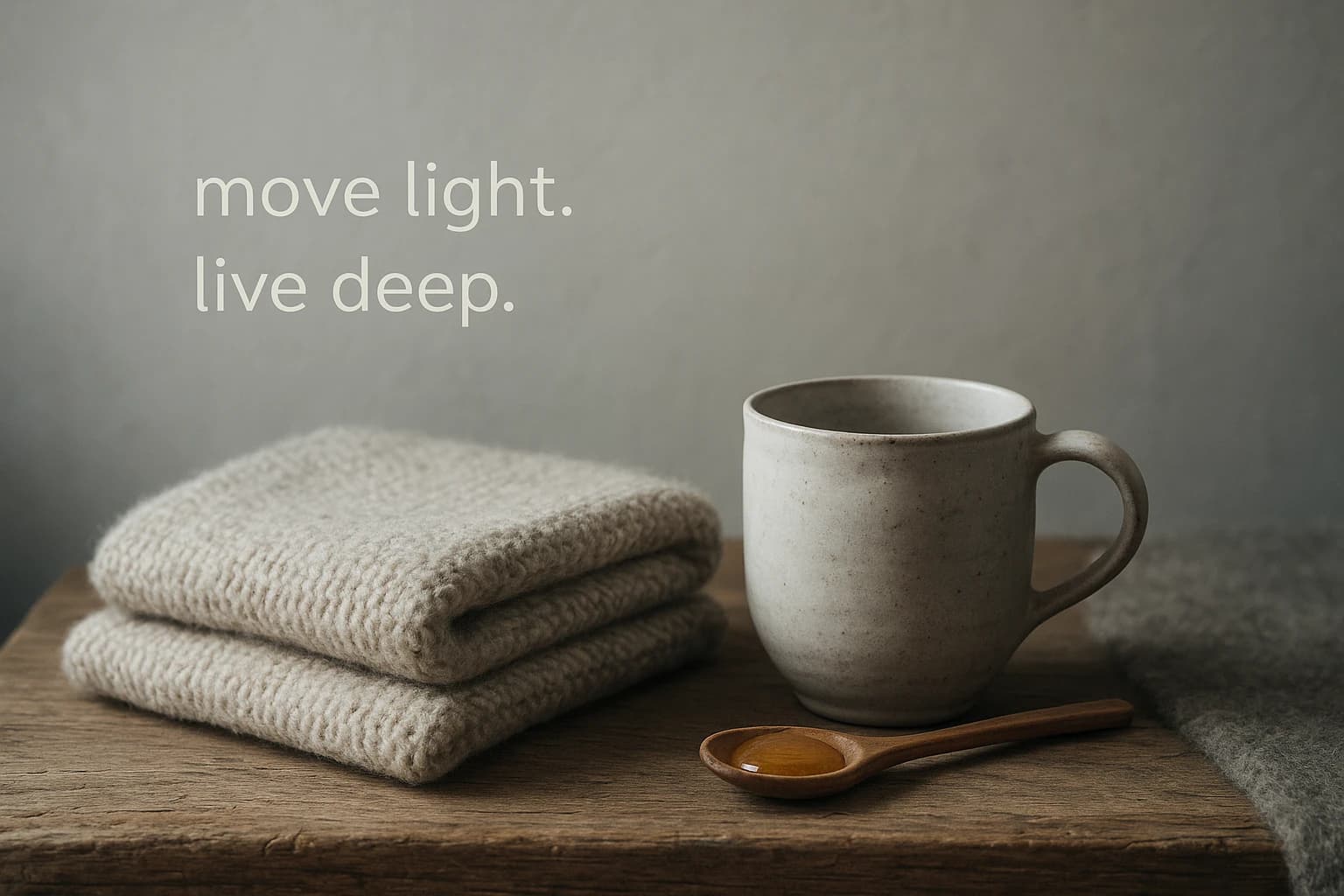
Welcome to the philosophy of the conscious home. This is not about empty rooms but about Mindful Curation — the art of surrounding yourself with few but meaningful things. Creating spaces that tell a story, are fairly traded, and touch us deeply. True to the motto: Move light. Live deep.
Beyond White Walls: Why We Don't Need Sterile Minimalism
When we think about minimalist living, we often picture cool, empty rooms. But this approach misses our fundamental psychological need for a sense of belonging. A home should embrace us, not keep us at a distance.
This is exactly where the S.L.O.W. approach comes in, which according to trend reports will shape interior design in the coming years. S.L.O.W. stands for Sustainable, Local, Organic, Whole. It is a departure from mass-produced transience toward objects crafted with ethical responsibility and artisanal tradition.
A conscious minimalism does not ask: "How much can I throw away?" but rather: "Which objects truly enrich my life?" It is the deliberate choice of quality over quantity.
The Psychology of Space: Neuroarchitecture for Mental Clarity
That cluttered rooms stress us is not imagination but measurable biology. So-called neuroarchitecture researches how our built environment influences our brain. Sensory overload from too many colours, shapes, and artificial materials in our living spaces keeps our nervous system in constant alert.
Research shows impressively: handcrafted objects with natural, irregular textures and organic forms measurably lower cortisol levels. While straight, hard lines in architecture signal stability, round forms and soft, natural materials like untreated wool or felt convey an evolutionary sense of safety.
Sensory Wellbeing: How Textures Lower Our Stress Levels
Imagine the difference: you enter a room with smooth laminate and synthetic furniture — or you slip into handcrafted slippers made from pure wool that feel like a second skin, and step onto a modern Shyrdak carpet whose felted texture breathes ancient craft traditions.
This includes the right light: bulbs below 2,700 Kelvin (warm white) signal relaxation to the body, similar to the light of a warming fire. These conscious sensory decisions transform a mere "flat" into a healing home.
From the Hive
Honey knowledge the supermarket skips
Twice a month: varietals, harvest, origin. Plus 10% off your first order.
10% off your first order · No spam. Unsubscribe anytime.
The Value of the Unique: The Art of Conscious Curation
In the decision-making phase for new interiors, we often stand at a crossroads: do we reach for cheap mass-produced goods, or invest in a genuine one-of-a-kind piece?
The philosophy of the conscious home always chooses the unique piece. Mass-produced goods fill the space but leave it emotionally empty. Handcrafted objects, on the other hand — whether an elaborately made felt carpet reflecting the raw nature of mountain landscapes at over 2,500 metres, or a scarf bearing the signature of its weaver — carry a soul within them. They bring the Wabi-Sabi principle into our home: the beauty of the imperfect, authentic, and transient.
The 3-Question Rule for a Mindful Home
To curate rooms like a gallery curator where every object earns its place, use this simple test before every purchase:
- Does it have a lasting function? (Is it so well-crafted that it will endure for decades?)
- Does it tell a story? (Do I know its origin? Was it traded fairly and directly?)
- Does it positively engage my senses? (Does it feel natural? Does it smell pleasant? Is it a pure natural material?)
If you answer these questions with yes, you are looking not at a mere consumer product but at a lifelong companion.
Minimalist and Mindful Furnishing: A Room-by-Room Guide
The Mindful Living Room: Cosy Minimalism
The living room is the heart. Instead of decorating with countless small items, opt for Cosy Minimalism. Choose a few large-scale statement pieces. A modern felt carpet that reinterprets archaic patterns is entirely sufficient to give a room character. Combine it with soft wool and natural wood. The room remains visually calm but offers the eye deep, fascinating textures to linger on.
The Home Office: Ideas for More Mindfulness
Our mind can only work as clearly as its surroundings allow. In the home office: clear lines for a clear mind. Hide cables and files. Use the desk only for essentials. But also create conscious islands of sensuality here — a handmade ceramic cup, sweetened with a spoonful of pure, rare mountain honey, transforms the stressful email break into a mindful ritual that immediately grounds you.
Minimalist Living: Tips for Small Flats (40sqm)
The reality for many people does not look like glossy magazine spreads. Especially in 40 square metres, mindfulness is not merely a lifestyle choice but a pure necessity.
- Multifunctionality: Choose furniture that serves multiple purposes.
- Visual depth: Keep the floor as clear as possible.
- Less is imperative: In small spaces, every thoughtless object immediately stands out. Buy less frequently, but in uncompromising quality.
Creating Order, Clearing the Mind: The Path to S.L.O.W. Living
According to surveys, 37 percent of Germans feel a deep sense of liberation after decluttering. But how to begin without falling into the dogmatic compulsion of strict decluttering methods?
Be gentle with yourself. Don't start with the goal of throwing away half your possessions. Start with the goal of identifying the things you truly love. Clear a single table completely. Then put back only the three objects that bring you genuine joy and hold meaning. Feel the effect of the emptiness between them. This emptiness is not a lack — it is space for thoughts, for peace, for life.
Conclusion: Move Light. Live Deep.
A conscious home is not created overnight. It is a journey — away from the loud culture of excess, toward a life carried by quality, culture, and mindfulness. Every object in your space is like a silent housemate. Choose housemates that are ethically pure, soothe your senses, and carry centuries-old craft traditions within them.
When we learn to surround ourselves only with what is truly valuable, our baggage becomes lighter, but our lives grow deeper.
Share
According to a Statista survey, 53 percent of Germans see their home primarily as a desperately needed retreat from hectic everyday life.
Handcrafted objects with natural, irregular textures and organic forms measurably lower cortisol levels.
S.L.O.W. stands for Sustainable, Local, Organic, Whole — a departure from mass-produced transience toward objects crafted with ethical responsibility and artisanal tradition.
Frequently Asked Questions
Is it so well-crafted that it will endure for decades? This is the first question of the 3-question rule for mindful home curation.
Do I know its origin? Was it traded fairly and directly? Knowing the provenance of objects in your home deepens your connection to them.
At first glance, ethically crafted unique pieces require a higher initial investment. But when you calculate the longevity of genuine natural materials against the constant replacement of mass-produced items, the conscious home is significantly more economical in the long run.
The secret lies in the materials. Avoid high-gloss surfaces, glass, and too much metal. Instead, opt for tactile stimuli: wool, felt, rough wood, and warm light sources (below 2,700 Kelvin). These natural materials also absorb sound, making the room acoustically softer.
Start with the things you touch daily. Reduce visible distractions (closed storage instead of open shelves). Invest in a few excellent everyday items that give you a feeling of luxury and comfort even in the smallest space.

Jamilia
Autorin, ULU Magazin
Jamilia schreibt über kirgisisches Handwerk, Honig und die Geschichten hinter den Produkten. Aufgewachsen in Zentralasien, lebt sie zwischen Bischkek und Berlin.
Related Articles

The Makers
What Is Sainfoin Honey? The Complete Guide to a Rare Honey
Some honeys you find in every supermarket. Then there is sainfoin honey.

The Makers
Luxury Honey: What Premium Honey Actually Means
The gap between a €3 supermarket honey and a €40 specialty jar is bigger than most people think. What real quality comes down to.

The Makers
Best Honey in Germany 2026
The best honey varieties in Germany 2026: From forest honey to acacia to Manuka — an honest comparison with ratings.
From the Hive
Honey knowledge the supermarket skips
Twice a month: varietals, harvest, origin. Plus 10% off your first order.
10% off your first order · No spam. Unsubscribe anytime.