
The Makers
How to Spot Synthetic Dyes in Textiles: A Simple Guide
Last updated:
Imagine standing in front of a rack of vibrantly coloured T-shirts. A rich blue, a fiery red, an intense green — the colours draw you in. But have you ever wondered where that perfectly radiant colour comes from? In a world where we think ever more consciously about what we eat and put on our skin, the origin of our clothing is also coming into sharper focus. And a fundamental part of that is the colour.
The distinction between synthetic and natural dyes is more than just a technical nicety. It is a first, important step towards more conscious consumption and a better understanding of the products that surround us every day. This guide is your personal compass. It is here to help you find initial clues without a chemistry degree or laboratory equipment, and to feel more confident in your choices.
A Quick Look into the Dye Pot: What Are Synthetic Dyes, Exactly?
When we speak of synthetic dyes, we mean colours that are artificially produced in a laboratory, usually from a petroleum base. Since their discovery in the 19th century, they have revolutionised the textile industry. Why? They are cheap to manufacture, extremely versatile, and enable an almost infinite palette of vibrant, stable shades that are often difficult to achieve with natural means.
In contrast, natural dyes are derived from plants, animals, or minerals. They tend towards subtler, earthier tones and can vary slightly from one dyeing batch to the next — a characteristic that speaks to their uniqueness.
It is important to understand: not every synthetic dye is inherently "bad." Many modern synthetic dyes are subject to strict controls. However, some — particularly in the fast fashion industry — can contain problematic chemicals or be used in manufacturing processes that are concerning for the environment and workers. Knowing what to look for gives you the power of choice.
Your First Clue: The Label as a Guide
Before you even put a single drop of water on the fabric, the small label inside your garment is the first and often most revealing source of information. It is like the table of contents of a book — you just need to know how to read it.
Check the Material Composition
The type of fibre gives a strong indication of the type of dyeing. Certain fabrics are difficult or impossible to dye with natural colours.
- Strong indicators of synthetic dyes: Polyester, polyamide (nylon), acrylic, elastane. These synthetic fibres form a strong chemical bond with synthetic dyes, which produces those vibrant, long-lasting colours.
- Could be either: Cotton, linen, viscose, modal. These fibres can be dyed both synthetically and naturally. You will need to look more closely here.
- Usually natural or dyed with certified colours: Untreated wool, silk, or organic cotton, especially when labelled as such.
Look for Certifications
Labels and seals are like trustworthy signposts in the jungle of product information. They guarantee that independent bodies have reviewed the production process.
- GOTS (Global Organic Textile Standard): This seal is the gold standard. It not only prohibits the use of toxic heavy metals and aromatic solvents in dyes, but also places strict requirements on the entire production process. A GOTS label is a very strong indicator of environmentally and health-compatible dyeing.
- OEKO-TEX Standard 100: This widely used label is also very helpful. It guarantees that the end product has been tested for a long list of harmful substances and is safe for health. It does not necessarily mean that no synthetic dyes were used, but it ensures that the colours used are free from harmful substances.
[Image: A collage of various care labels with highlighted material information such as "100% Polyester" and certification logos like GOTS and OEKO-TEX.]
From the Hive
Honey knowledge the supermarket skips
Twice a month: varietals, harvest, origin. Plus 10% off your first order.
10% off your first order · No spam. Unsubscribe anytime.
Spotting With the Naked Eye: Visual and Tactile Tests
Sometimes a garment reveals its story through its appearance and how it feels. Sharpen your eye for the small but significant differences.
The Telltale Colour Edges
This is an often overlooked but very useful clue. Examine a pattern or printed area of the fabric very closely.
- Synthetic dyeing: The edges between different colours or patterns are often extremely sharp, precise, and uniform, almost as if digitally printed. The colour appears flat and often does not penetrate deeply into the weave.
- Natural/artisanal dyeing: The transitions are often softer. The colour seems to "live" more within the fabric and may "bleed" slightly at the edges or appear more irregular. These small imperfections are a hallmark of handwork and natural processes.
Sheen and Uniformity
The perfection of the colour can also be an indicator.
- Synthetic dyeing: The fabric often shows an absolutely flawless, almost artificially uniform colour consistency across its entire surface. Sometimes this is accompanied by a slight, unnatural sheen, especially with synthetic fibres.
- Natural dyeing: Here you often find subtle nuances and slight variations in colour intensity. The fabric looks more alive and more matte. This uniqueness is a quality hallmark valued by connoisseurs — a principle we especially cherish when selecting our handcrafted wool products from Kyrgyzstan.
[Image: A side-by-side comparison photo. Left: a machine-printed polyester fabric with razor-sharp, uniform colour edges. Right: a hand-dyed wool fabric with softer, organic colour transitions.]
The Home Lab Check: Simple Tests with Water and Alcohol
If you want to know more precisely, you can carry out small tests with simple supplies everyone has at home. Important note: always perform these tests first on an inconspicuous area (e.g. the inside of a seam) to avoid damaging the fabric.
The Water Drop Test
This test checks so-called colour fastness and can provide clues about the quality of the dyeing.
- Preparation: Take a white cloth or piece of kitchen paper and place it under the area to be tested.
- Procedure: Place a drop of lukewarm water on the fabric.
- Observation: Press another white cloth gently onto the wet spot from above. Does the colour bleed immediately and intensely, leaving a vivid stain on the white cloth? This can be a sign of low-quality, poorly fixed synthetic dyes. Natural dyes can also bleed slightly, but the effect is often less intense and the colour tone appears "earthier."
The Alcohol Rub Test
Many synthetic dyes dissolve better in alcohol than in water. We can use this to our advantage.
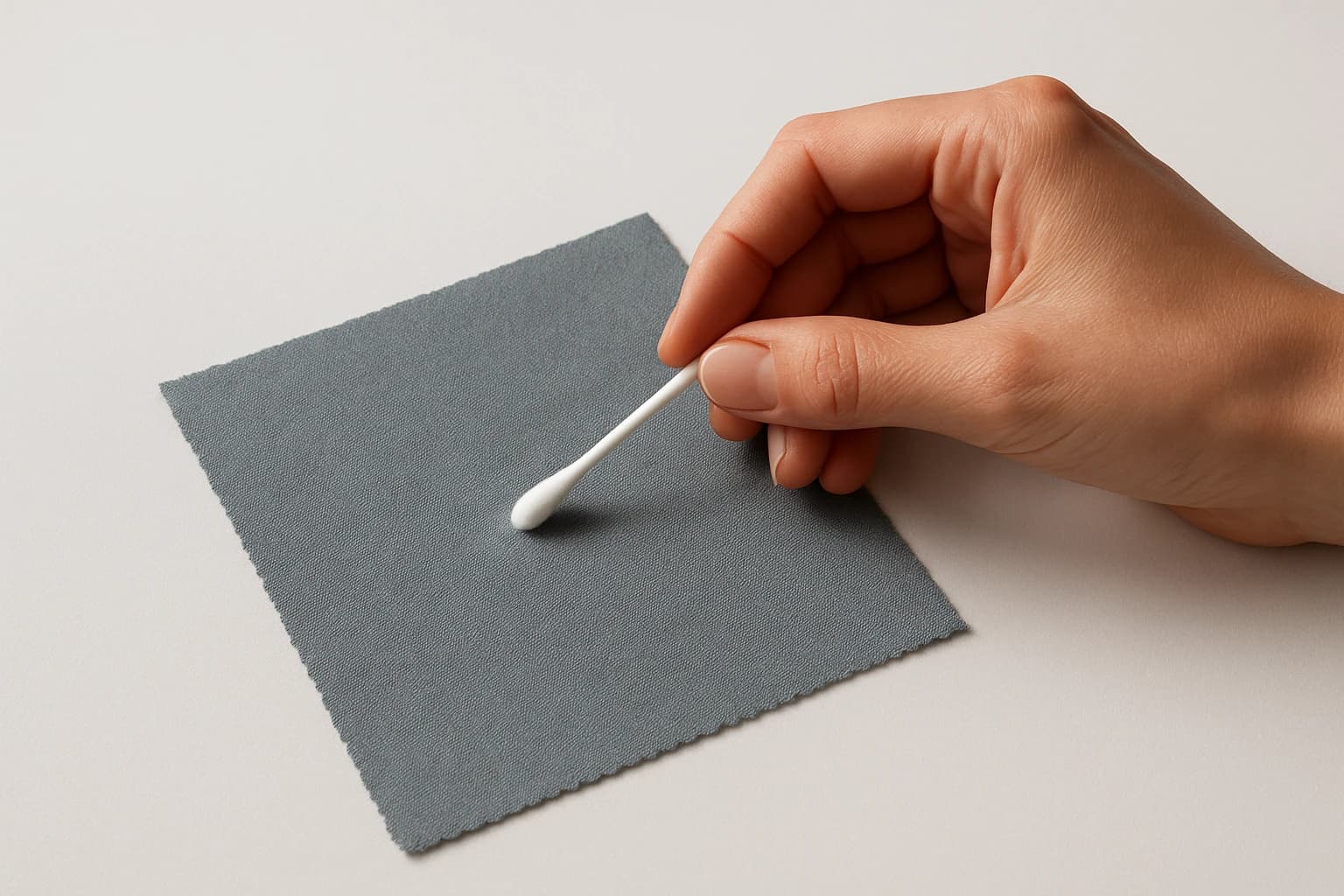
- Preparation: You will need a cotton swab and some rubbing alcohol (isopropanol) from the pharmacy or drugstore.
- Procedure: Moisten the cotton swab with the alcohol and rub it gently with light pressure over a hidden area of the fabric.
- Observation: Check the cotton swab. If a noticeable, vivid colour has transferred onto the swab, there is a high probability that it is a synthetic dye. With high-quality dyed fabrics (whether natural or synthetic), little to no colour should come off.
[Image: A step-by-step visual guide for the alcohol rub test: 1. A cotton swab is dipped into a bottle of isopropanol. 2. Gentle rubbing on the inner seam of a bright blue pair of jeans. 3. The cotton swab shows a clear blue colour transfer.]
Frequently Asked Questions (FAQ)
Are synthetic dyes always harmful? No, not necessarily. In the EU, many potentially harmful azo dyes are banned. Certifications like OEKO-TEX Standard 100 provide additional safety. The problem often lies in unregulated production countries and the fast fashion industry.
Does "colour bleeding" always mean the dye is synthetic? Not always, but the intensity and shade can be a clue. Vivid pink, blue, or neon green bleeding strongly points to synthetic dyes. Newly purchased jeans often bleed too — this is the synthetic indigo dye at work.
Why are synthetic dyes so widespread? They are cost-effective, durable, wash-resistant, and enable a vast, reproducible colour palette that is ideal for industrial mass production.
Can I rely 100% on labels? Reputable, independent certifications like GOTS or OEKO-TEX are very trustworthy. They are the best tools consumers have for making informed decisions.
From Spotting to Conscious Choosing
Knowing how to spot synthetic dyes is not meant to unsettle you, but to empower you. It is not about avoiding everything synthetic from now on, but about making conscious decisions. With every label you read and every fabric you examine more closely, you are training your eye and your awareness.
You now have the first tools in hand:
- Read: Check the label for material and certifications.
- Look: Pay attention to colour edges, uniformity, and sheen.
- Test: If in doubt, carry out a water or alcohol test on a hidden spot.
This path of conscious looking leads to a deeper appreciation for quality, craftsmanship, and the stories woven into our textiles. If you are now curious, we invite you to take it one step further. Learn more about the fascinating differences between natural and synthetic dyes and discover a world of vibrant tradition and sustainable beauty.
Share
Synthetic dyes are artificially produced in a laboratory, usually from a petroleum base — since the 19th century, they have revolutionised the textile industry.
Natural dyes tend towards subtler, earthier tones and can vary slightly from one batch to the next — a characteristic that speaks to their uniqueness.
The type of fibre gives a strong clue about the type of dye: polyester, polyamide, and acrylic form chemical bonds almost exclusively with synthetic dyes.
Frequently Asked Questions
Does "colour bleeding" always mean the dye is synthetic? Not always, but the intensity and shade can be a clue. Vivid pink, blue, or neon green bleeding strongly points to synthetic dyes. Newly purchased jeans often bleed too — this is the synthetic indigo dye at work.
Why are synthetic dyes so widespread? They are cost-effective, durable, wash-resistant, and enable a vast, reproducible colour palette that is ideal for industrial mass production.
Can I rely 100% on labels? Reputable, independent certifications like GOTS or OEKO-TEX are very trustworthy. They are the best tools consumers have for making informed decisions.

Jamilia
Autorin, ULU Magazin
Jamilia schreibt über kirgisisches Handwerk, Honig und die Geschichten hinter den Produkten. Aufgewachsen in Zentralasien, lebt sie zwischen Bischkek und Berlin.
Related Articles

The Makers
What Is Sainfoin Honey? The Complete Guide to a Rare Honey
Some honeys you find in every supermarket. Then there is sainfoin honey.

The Makers
Luxury Honey: What Premium Honey Actually Means
The gap between a €3 supermarket honey and a €40 specialty jar is bigger than most people think. What real quality comes down to.

The Makers
Best Honey in Germany 2026
The best honey varieties in Germany 2026: From forest honey to acacia to Manuka — an honest comparison with ratings.
From the Hive
Honey knowledge the supermarket skips
Twice a month: varietals, harvest, origin. Plus 10% off your first order.
10% off your first order · No spam. Unsubscribe anytime.