
The Makers
Timeless Design Principles of Kyrgyz Patterns and Their Enduring Appeal
Last updated:
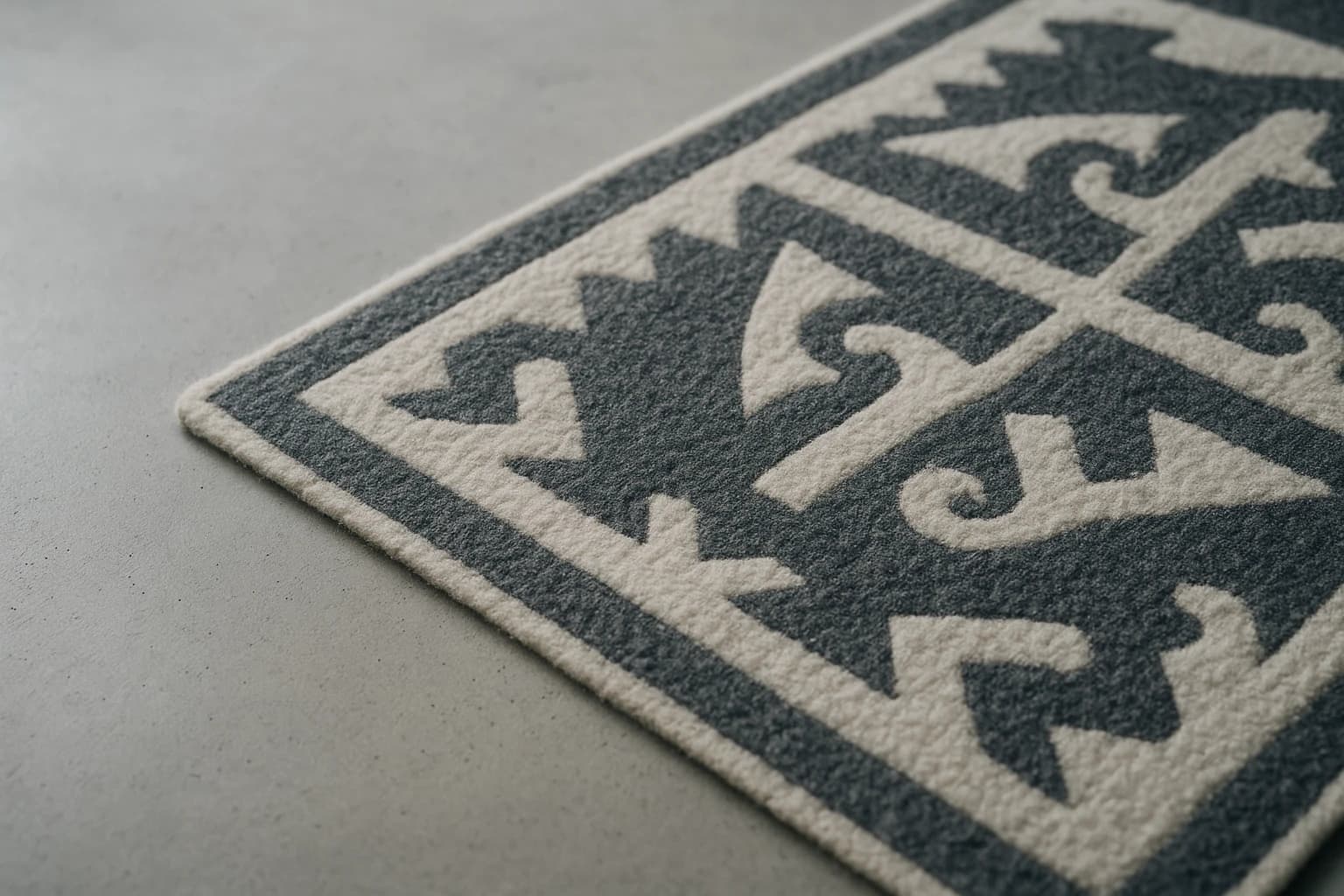
If you're in the process of choosing interiors for your home, you're probably facing a familiar dilemma: you want pieces that bring warmth, character, and a story into your rooms. At the same time, you want to avoid losing elegance to overloaded or mass-produced ethno decoration. You're not looking for a mere object — you're looking for a piece of culture that integrates seamlessly into your modern life.
This is precisely where the centuries-old nomadic tradition from the mountains of Kyrgyzstan reveals its true strength. The craftsmanship cultivated by herding families at over 2,500 metres provides remarkably precise answers to the most contemporary European interior questions.
Let us look behind the scenes of the ULU collections and explore why traditional Kyrgyz patterns create such an irresistible resonance across cultures and eras.
The Architecture of the Shyrdak: The Principle of Duality and Zero-Waste Design
Before we talk about visual impact, we need to understand how Kyrgyz felt carpets — known as Shyrdaks — are actually constructed. Hidden within is a concept that the modern design world is currently celebrating as revolutionary, yet which has been standard practice in Central Asian yurts for centuries: the absolute zero-waste principle.
To create a Shyrdak, the artisans layer two densely fulled felt sheets in contrasting colours on top of each other. The desired pattern is then cut simultaneously through both layers. The cut-out motifs are then cross-inserted into the opposite-coloured base and sewn in place.
The fascinating result? Two carpets are always created at exactly the same time — a positive and a negative. There is simply no waste whatsoever.
This mosaic-cut principle demands not only unparalleled craftsmanship precision, but gives every ULU carpet a deeper meaning: somewhere in the world, the exact "soul twin" of your carpet exists in inverted colours. This archaic form of sustainability builds a direct bridge to our modern understanding of ecological and ethical design.
Nature as Geometry: Kyrgyz Patterns Deconstructed
A common reservation about traditional craftsmanship is the fear of visual restlessness. But anyone who looks closely at Kyrgyz patterns discovers a fascinating parallel to the European Bauhaus school: radical geometric abstraction.
The women in the highland steppes don't weave and felt realistic landscape paintings. They distil their rugged, majestic surroundings into clear, symmetrical codes. The famous Kochkor muyuz (ram's horn) pattern symbolises wealth and protection, but is visually abstracted into a powerful, sweeping spiral. The Suu (water) motif appears as a rhythmic zigzag line, while stylised mountain ranges are immortalised in razor-sharp triangular ornaments.
This simplification of nature into diamonds, spirals, and triangles is the reason these designs feel so timeless. If you'd like to dive deeper into the meaning of individual symbols, we recommend our guide Decoding the Geometry of Shyrdak Patterns.
From the Hive
Honey knowledge the supermarket skips
Twice a month: varietals, harvest, origin. Plus 10% off your first order.
10% off your first order · No spam. Unsubscribe anytime.
From the Yurt to the European Loft: Why This Symbiosis Works So Perfectly
You might be wondering at this point: "Does a traditional nomadic carpet really suit my minimalist exposed concrete floor or my Scandinavian oak parquet?"
The answer from interior architecture is a resounding yes — precisely because of the contrast. Modern European architecture tends toward large, open spaces with smooth, hard surfaces. This can quickly feel cool and sterile. A handcrafted Shyrdak carpet or a cushion cover with clean Kyrgyz ornaments breaks through this severity not with chaos, but with structured symmetry.
Minimalism meets ethno-expressionism. The strict symmetry of the patterns organises the space visually. It offers the eye an anchor point without overwhelming the room. We explore in detail how to use ancient design languages as deliberate style elements in our article Traditional Forms in a Modern Context.
Smart Functionality: When Design Shapes Your Indoor Climate
As a conscious consumer, you know: good design must do more than simply look beautiful. It must serve a function. Here, Kyrgyz craftsmanship demonstrates why it was rightfully added to the UNESCO Intangible Cultural Heritage list in 2012.
The dense fulled felt technique using 100% pure highland virgin wool offers physical properties where modern synthetic materials often fall short:
- Acoustic dampening: In minimally furnished, large rooms, the dense felt absorbs reverberation extremely effectively, creating a quiet, muted room atmosphere.
- Climate regulation: Virgin wool is naturally breathable and moisture-regulating. It provides excellent insulation against rising floor cold in winter without feeling hot in summer.
- Extreme durability: A well-cared-for Shyrdak is not made for a single season, but for generations. A lifespan of 30 to 100 years is not uncommon — the ultimate counter-model to short-lived fast furniture.
The ULU Philosophy: Authenticity in Its Purest Form
Our guiding principle Move light. Live deep. is reflected in every knot and every cut of our collection. At ULU, we work without middlemen, directly with the artisans on the ground. This direct partnership guarantees not only fair wages but also the preservation of an untouched, authentic tradition.
The colour palette of our collections closely follows what nature provides. The deep reds, earthy browns, and rich blues tell stories of pomegranate, walnut, and vast skies. Discover how these nuances are sourced and combined in our detailed guide to colour theory in Kyrgyz textiles.
Understanding Symmetry and Asymmetry in Design
While most carpets are built on strict symmetry, our modern Shyrdak carpets and the Highland Wool Collection also feature deliberate asymmetries — small, charming irregularities that bear the individual weaver's signature. These are precisely the nuances that distinguish a living, genuine work of art from a machine-made copy. Learn more about this fascinating interplay in Symmetry and Asymmetry in Design.
Frequently Asked Questions (FAQ): Your Decision Guide
Your Next Step Toward Timeless Design
Choosing handcrafted interiors is choosing values, tactility, and a long-term living culture. Kyrgyz design principles offer you the rare opportunity to unite functional excellence, ethical responsibility, and architectural aesthetics in a single element.
ULU is currently preparing to bring these masterpieces to Europe in strictly limited editions. If you value design that tells a real story, we invite you to become part of our community.
Subscribe to our newsletter for exclusive order now to our opening collection. Secure early insights into our Modern Shyrdak Carpets, the featherlight Steppe Ballerinas, and the Highland Wool Collection — and shape your home by the principle: Move light. Live deep.
Share
When making a Shyrdak, two felt sheets are cut simultaneously — always producing exactly two carpets, a positive and a negative, with absolutely zero waste.
Somewhere in the world, the exact soul twin of your Shyrdak carpet exists in inverted colours — the absolute zero-waste principle.
Kyrgyz patterns show a fascinating parallel to the European Bauhaus school: radical geometric abstraction distilled from the raw mountain landscape.
Frequently Asked Questions
No. Because the patterns are strictly geometric and symmetrically arranged, they paradoxically bring calm and structure to a room. Unlike wild, floral patterns, Kyrgyz designs have an ordering and grounding effect. They work perfectly as a central focal point in an otherwise understated space.
The production is circular by nature. We use exclusively natural virgin wool from sheep that graze freely in the highlands. The traditional two-colour cut pattern (positive/negative) ensures zero percent material waste in carpet production. Moreover, the extreme longevity of the products means resources are conserved.
That is a very important question. Cultural appropriation occurs when designs are stolen, stripped of their context, and cheaply mass-produced by machine. ULU stands for the exact opposite: cultural appreciation. We work in direct trade on equal footing with Kyrgyz artisan families. Every piece is produced by the culture bearers themselves under fair conditions. When you purchase a ULU product, you actively contribute to preserving this UNESCO Intangible Cultural Heritage.

Jamilia
Autorin, ULU Magazin
Jamilia schreibt über kirgisisches Handwerk, Honig und die Geschichten hinter den Produkten. Aufgewachsen in Zentralasien, lebt sie zwischen Bischkek und Berlin.
Related Articles

The Makers
What Is Sainfoin Honey? The Complete Guide to a Rare Honey
Some honeys you find in every supermarket. Then there is sainfoin honey.

The Makers
Luxury Honey: What Premium Honey Actually Means
The gap between a €3 supermarket honey and a €40 specialty jar is bigger than most people think. What real quality comes down to.

The Makers
Best Honey in Germany 2026
The best honey varieties in Germany 2026: From forest honey to acacia to Manuka — an honest comparison with ratings.
From the Hive
Honey knowledge the supermarket skips
Twice a month: varietals, harvest, origin. Plus 10% off your first order.
10% off your first order · No spam. Unsubscribe anytime.