
Travel Light
Hunting with Eagles: An Ancient Tradition of Kyrgyz Nomads
Last updated:
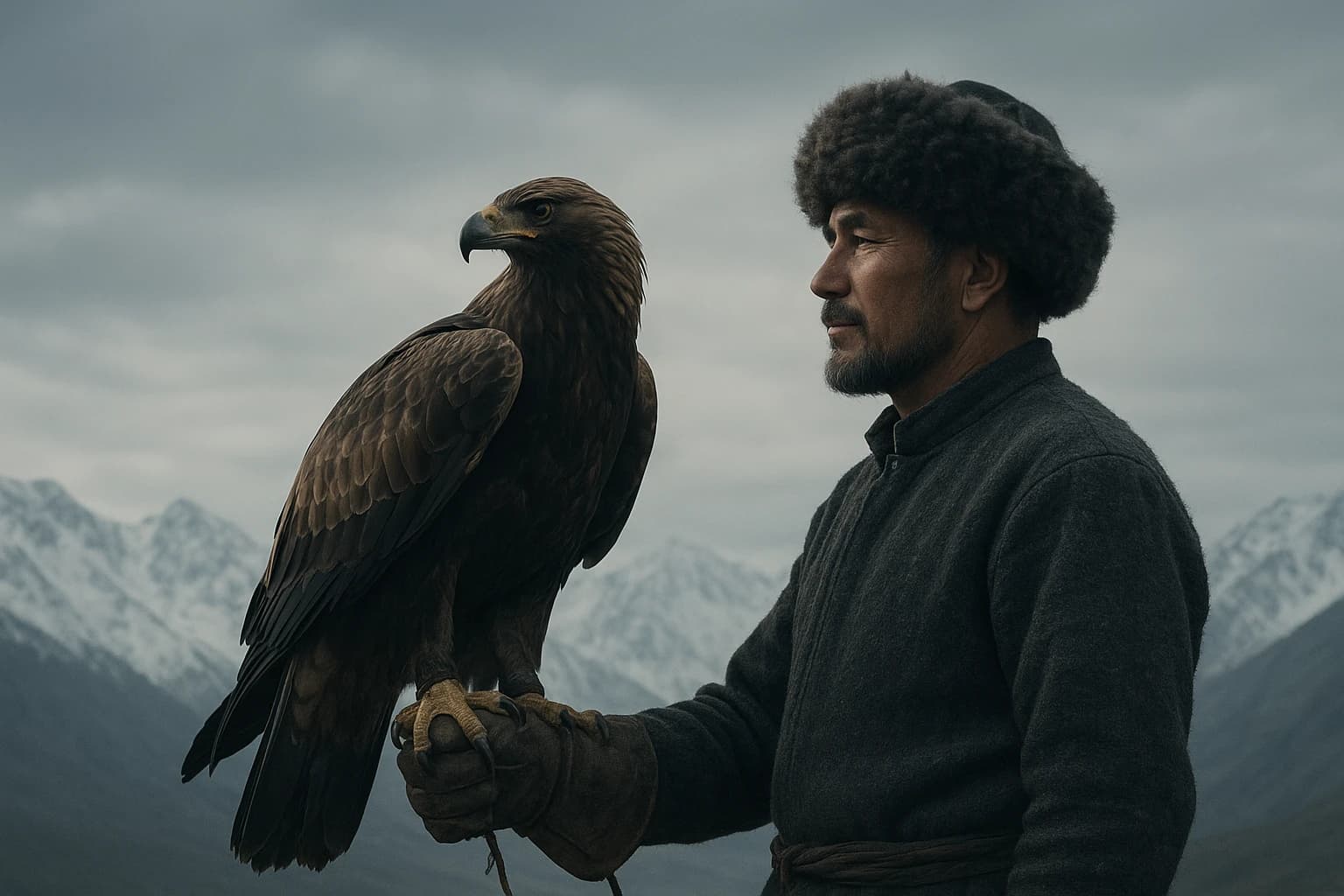
Golden eagle hunting — known as Berkutchi — is a 3,000-year-old tradition of Kyrgyz nomads that transforms the relationship between human and raptor into a deep, spiritual partnership. Unlike European falconry, Berkutchi was never a pastime for nobility but a survival skill woven into nomadic life itself.
What Is Berkutchi? More Than a Hunting Technique
When we speak of eagle hunting or Berkutchi, we don't mean falconry as it's known in Europe. In Kyrgyzstan, it is not a leisure pursuit for the aristocracy but a survival art deeply rooted in the nomadic way of life and cultural identity. For a nomad, the eagle was not merely a tool but a family member, a partner who helped secure valuable furs and meat during harsh winters.
The tradition is over 3,000 years old and has its roots in the steppes of Central Asia. A true eagle hunter, a Münüshkör, is not simply a trainer. He is someone who possesses a special gift, a "calling," to communicate with these powerful birds. This ability is often passed down within families and is considered a sacred duty.
The Golden Eagle: Anatomy of a Perfect Hunter
To understand the fascination of Berkutchi, one must first understand the golden eagle itself. This bird is a masterpiece of evolution and a symbol of power and freedom.
- Eagle eyes: A golden eagle can see up to eight times more sharply than a human. It can spot a hare from over three kilometers away — an ability that makes it the perfect scout in the vast steppe.
- Deadly speed: In a dive, the eagle reaches speeds of over 300 km/h. This lightning-fast attack gives prey virtually no chance of escape.
- Immense power: A golden eagle's talons exert a grip force of up to 53 bar (750 psi) — more than a lion's bite. They are designed not just for gripping but often kill prey instantly through a precise grip that breaks the neck.
These incredible abilities make the eagle an invaluable partner, but also a formidable challenge for the hunter who must earn its trust.
From the Hive
Honey knowledge the supermarket skips
Twice a month: varietals, harvest, origin. Plus 10% off your first order.
10% off your first order · No spam. Unsubscribe anytime.
The Art of the Münüshkör: A Partnership for Years
The relationship between a Berkutchi and his eagle begins early and requires years of patience, dedication, and deep understanding of the bird's nature.
Training: A Dialogue Without Words
Training an eagle takes three to four years and is an intensive process that creates an inseparable bond.
- The capture: Traditionally, young female eagles (they are larger and stronger than males) are taken from the nest. This is a dangerous undertaking that requires respect for the animal and nature.
- The hood (Tomogo): The most important tool is a leather hood that covers the eagle's eyes. In darkness, the bird remains calm and can slowly accustom itself to the presence and voice of its human.
- The voice: The hunter spends countless hours speaking to his eagle and singing to it. The bird learns to recognize and trust its partner's voice.
- The hand: The eagle spends most of its time on its hunter's specially protected arm. The Berkutchi learns to feel "the slightest movement of its talon" and interpret the bird's intentions.
This training is not about breaking the bird's will but building mutual trust. The eagle does not hunt because it is forced to, but because it sees the hunter as a partner who helps it succeed.
The Hunt: A Silent Ballet in the Winter Steppe
The actual hunting season runs from October to February, when snow reveals the tracks of prey animals and furs are at their most valuable. The hunt itself is a fascinating interplay of human, horse, often a Taigan (Kyrgyz greyhound), and the eagle.
The hunter rides to an elevated point, removes the eagle's hood, and lets it scan the landscape. As soon as the eagle spots prey — usually foxes, hares, or badgers — it launches from the hunter's arm. The attack is swift and silent. The Berkutchi follows on horseback to assist the eagle and secure the catch. A well-practiced team can take over 50 foxes in a season, which once meant the difference between survival and hardship for a nomadic family.
The connection to nature is central here. The hunt is not an act of dominance but fits into the cycle of life.
Between Tradition and Modernity: The Future of the Berkutchi
Today, the Berkutchi face new challenges. The traditional nomadic way of life is giving way to modern structures, and the number of true eagle hunters has declined sharply. Yet the tradition lives on, strengthened by a new awareness of its cultural heritage.
In 2016, eagle hunting was recognized by UNESCO as an Intangible Cultural Heritage of Humanity. This has helped preserve the art and encouraged young people to continue the tradition of their ancestors.
At the same time, tourism has created a new role. While it offers a source of income, it also carries the danger of commercialization. It is a fine line between an authentic demonstration for interested visitors and a mere show that misses the spirit of the tradition. True Berkutchi do not hunt for tourists; they demonstrate their art and the deep bond with their bird.
Myth and Reality: What You Should Know About Eagle Hunting
Many misconceptions surround the Berkutchi tradition. Here are some of the most common myths and the reality behind them:
- Myth: Eagle hunting is cruel and the birds are enslaved. Reality: The relationship is based on deep respect. After approximately 10 to 20 years of hunting together, the eagle is released back into the wild in a ceremonial act so it can breed and complete the cycle of nature. This is the final and greatest act of respect from the hunter toward his partner.
- Myth: You can watch eagle hunters hunting all year round. Reality: The real hunt takes place only in winter. What tourists often see in summer are demonstrations of the skills of human and bird, not the actual hunt.
- Myth: It is a purely male tradition. Reality: Traditionally it has been almost exclusively men, but there are historical legends and rare modern examples of women who also master this art, breaking rigid gender roles.
The Call of the Mountains: A Legacy That Lives On
The art of the Berkutchi is a living testament to a time when survival depended on harmony between human and nature. It teaches us that a partnership across species boundaries is possible when it is built on respect, patience, and deep understanding.
In a world that spins ever faster, the eagle hunters of Kyrgyzstan remind us of the value of slowness, tradition, and the unbreakable connection to the wild soul of nature.
Share
The Berkutchi tradition is over 3,000 years old, rooted in the steppes of Central Asia, where eagle hunting was a survival art woven into nomadic life itself.
A golden eagle's talons exert a grip force of up to 750 psi — more than a lion's bite — and can spot a hare from over three kilometres away.
In a dive, the golden eagle reaches speeds of over 300 km/h, giving prey virtually no chance of escape.
Frequently Asked Questions
Berkutchi is the Kyrgyz term for traditional hunting with golden eagles. It is a millennia-old art and an important part of nomadic cultural heritage, based on a deep partnership between hunter and eagle.
Training takes several years and is based on trust, not coercion. Using a leather hood, the hunter's voice, and constant physical contact, the eagle gradually accustoms itself to its human partner until they can operate as a team.
They primarily hunt animals with valuable furs such as foxes and hares. A strong, experienced eagle can also take down larger prey such as young wolves.
From the Berkutchi perspective, it is a deeply ethical practice based on respect for nature. The eagle is seen as a partner, not a tool, and after its years of service is released back into the wild to breed.
Yes, but it is important to travel responsibly. Look for authentic experiences at festivals like Salbuurun or book visits with hunters who want to share their culture, rather than supporting purely tourist shows.

Jamilia
Autorin, ULU Magazin
Jamilia schreibt über kirgisisches Handwerk, Honig und die Geschichten hinter den Produkten. Aufgewachsen in Zentralasien, lebt sie zwischen Bischkek und Berlin.
Related Articles

Travel Light
Responsible Tourism in Kyrgyzstan: Travelling with Purpose
Anyone planning a trip to the other side of the world today is often looking for more than just relaxation. Perhaps you know this feeling: the Western pressure to perform becomes too much, and the thought of "travel as escape" creeps in. Yet the standard package-holiday conveyor belt of mass tourism often leaves an inner emptiness and a massive ecological footprint.

Travel Light
More Than Just Honey: The Liquid Gold of Kyrgyzstan
If you are looking for genuine Kyrgyz honey, you face a real challenge. You will find countless offers, yet most raise more questions than they answer. Where exactly does this honey come from? Who are the people behind it? And what truly makes it special enough to justify a higher price?

Travel Light
Kymyz, Juniper Smoke and Pilgrim Springs: Rituals of the Kyrgyz Nomads
Kymyz from a wooden vessel, juniper smoke before moving in, springs with their own legends on Issyk-Kul: three rituals that still shape the Kyrgyz nomads' summer.
From the Hive
Honey knowledge the supermarket skips
Twice a month: varietals, harvest, origin. Plus 10% off your first order.
10% off your first order · No spam. Unsubscribe anytime.