
Good to Know
How to tell if honey is real: five checks you can do at home
Of 320 honey samples pulled at the EU border, 147 were suspected of having been cut with syrup. That is 46 percent of the samples, and in every one of them the marker was sugar that did not come from nectar. The figure comes from the European Commission, not from a beekeeping association, which is why the question of real honey is being asked so often right now. Part of the answer is printed on the jar. The rest sits in a lab report, and no kitchen test will get it out.
In short
You can tell real honey at home from the label, the crystallisation and the price, not from the water test. In the EU coordinated action From the Hives, 147 of 320 border samples carried markers for foreign sugar, or 46 percent (European Commission). In law, honey is a product to which nothing may be added and from which nothing belonging to it may be taken. Everything beyond that is a laboratory question.
How much honey on the shelf is actually honey?
16 EU member states, Norway and Switzerland drew samples from imported honey consignments between November 2021 and February 2022 and had them tested for sugar that does not come from nectar. The analysis was done by the Commission's Joint Research Centre.
147 of 320 samples carried markers for foreign sugar, or 46 percent
EU coordinated action From the Hives, samples taken at the EU border
(European Commission)
Flagged means this: markers turned up for sugars that do not come from nectar, mostly rice, wheat or beet. A comparable control some years earlier found signs of foreign sugar in 14 percent of samples. Whether the problem quadrupled or the detection methods improved cannot be read off those two figures, and the Commission does not claim it can.
Two qualifications belong with the number. First, these are samples taken at the external border, not a survey of German supermarket shelves. Second, suspicion is not proof. Every flagged consignment has to be traced individually, and the report lists that as the task ahead rather than as a finding.
From the Hive
Honey knowledge the supermarket skips
Twice a month: varietals, harvest, origin. Plus 10% off your first order.
10% off your first order · No spam. Unsubscribe anytime.
What does real honey mean in law?
The EU Honey Directive keeps this brief. Honey sold as honey may have no food and no additive mixed into it. The rule also runs the other way: pollen and other constituents particular to honey may not be removed, unless that is unavoidable when foreign matter is sieved out.
Then there is one number worth remembering. Moisture may not exceed 20 percent. That lack of water is where honey gets its keeping quality, and it is also the reason honey crystallises at all, because the sugar solution is supersaturated.
What the directive does not provide is a test for the shopper. There is no official quick check you can run at the shelf.
How do you tell if honey is real at home?
Five checks, in this order. None of them is proof. Together they give you a picture.
1. The origin line. The EU has tightened its Honey Directive here. For blends, every country of origin has to be listed, in descending order of share. The old catch-all wording about blends of EU and non-EU honeys no longer does the job. A jar carrying a list of countries is a blend. A jar naming one country is easier to trace back, and the label does not have to spell that out.
2. The ingredient list. Pure honey has none, because it consists of one thing. If something is listed, the product is legally no longer honey and needs a different name; honey preparation is the usual one. That can be perfectly fine, but it changes the category.
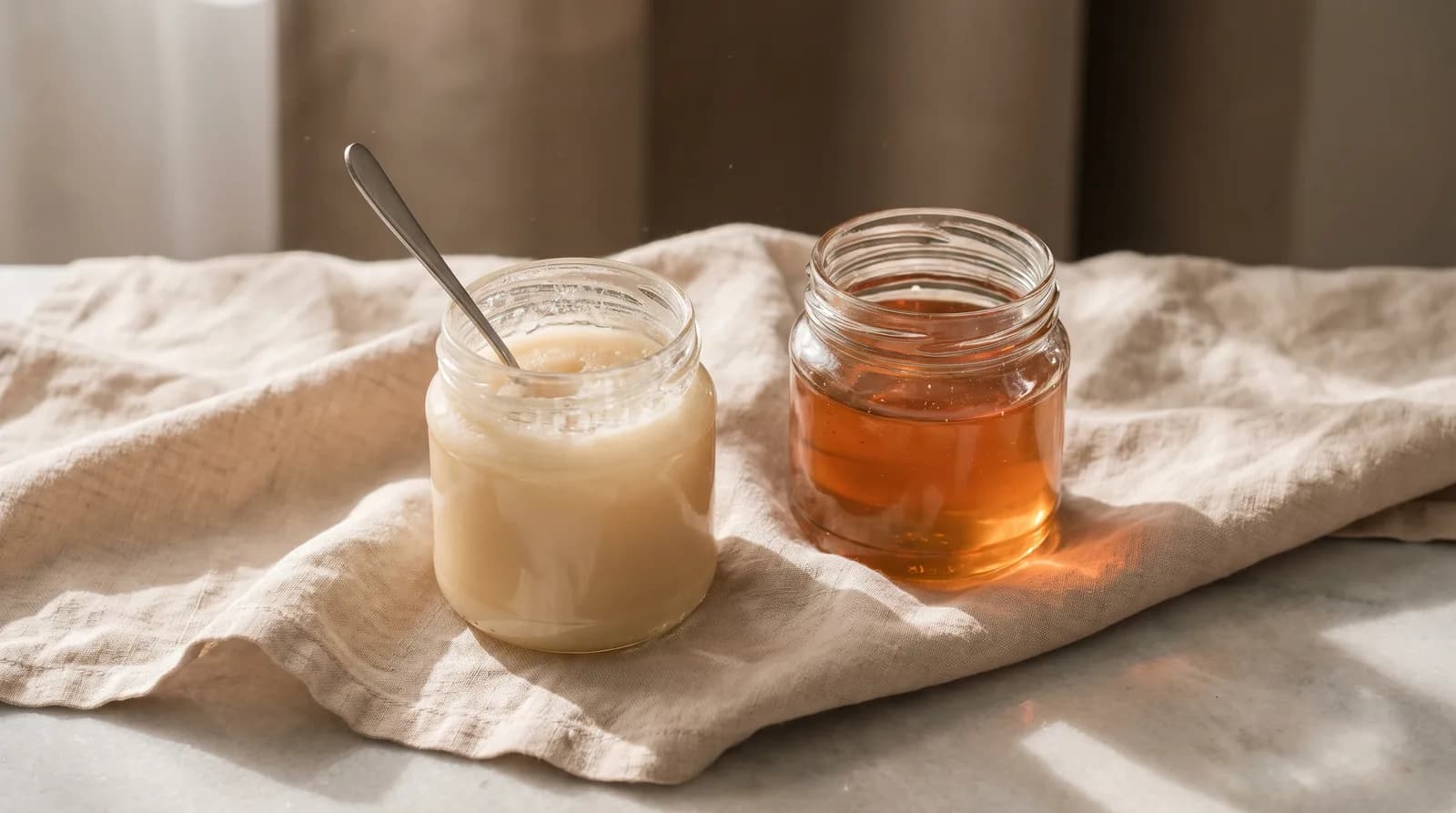
3. The crystallisation. Set, grainy or creamed honey is the normal case. The directive names crystallised honey as one of the forms honey takes. The opposite is the odd one: a jar that stays clear and runny for months. There are harmless explanations, acacia honey with a high fructose share among them. There is also the other kind. Why honey sets and what that tells you is covered in full under crystallised honey: why real honey turns solid.
4. The price per kilogram. Work the jar price up to a kilo and compare it with what a beekeeper in your region charges. Honey from a single harvest, bottled and shipped on its own, struggles to undercut that price. A wide gap downwards is not an accusation, but it is a question.
5. The question you put to the seller. Anyone selling honey should be able to say which harvest the batch comes from and whether an analysis exists. Getting an answer matters more than what the answer contains. A seller who does not understand the question has never asked it either.
Those five points are as far as you can get on authenticity by yourself. The other question, whether a real honey is also a good one, turns on processing, variety and taste. That has its own piece: recognising honey quality.
What do the water test, thumb test and flame test show?
These three have been circulating for years, and they are the reason many people believe they have checked their honey.
| Test | What it measures | What it says about authenticity |
|---|---|---|
| Water test, spoon into cold water | viscosity and density | nothing solid. Both depend on moisture and on temperature |
| Thumb test, drop holds its shape | surface tension and viscosity | nothing solid. Warmer honey runs, cooler honey holds |
| Flame test, wick burns | moisture of the sample | nothing solid. Glucose syrup burns too |
These tests are not sloppy. They measure something that has nothing to do with the question.
How does a laboratory detect honey cut with syrup?
Two methods carry most of the load. Carbon isotope analysis exploits a difference in plant metabolism: maize and sugar cane take up carbon differently from the flowering plants that bees forage. Syrup made from those plants therefore leaves a different isotope signature. Nuclear magnetic resonance adds a chemical fingerprint of the sample.
Both have limits, and those limits are set out openly in the literature. Isotope analysis is the technique that is broadly accepted, while findings from resonance and mass spectrometry are contested among the parties involved. A harmonised official method that every control laboratory could lean on still does not exist (npj Science of Food).
No harmonised official method for foreign sugar
Isotope analysis alone is broadly accepted
(npj Science of Food)
Where the literature is careful, a blog article should be careful too.
What our own jar says
Our honey is sainfoin honey, country of origin Kyrgyzstan, not a blend. It arrives creamy white and finely crystallised, and it stays that way as long as it is kept cool. An analysis from the country of origin exists. A full European analysis across all values does not yet. We write that down because it is where things stand.
How to store a jar like that so the fine crystallisation survives is covered under storing honey and understanding crystallisation. Why this honey is white in the first place is explained in the guide to white honey.
The check that actually counts
Read the origin line on the front of the label. It is one of the few statements on the label that somebody had to write against their own interest.
Share
Frequently Asked Questions
Most reliably through the label and the price, not through a kitchen test. Read the origin line, read the ingredient list, and work the price out per kilogram. Crystallisation counts in favour of real honey, not against it. None of these steps settles the question for good; that takes a laboratory.
Not as proof of authenticity. The water test shows how viscous a sample is, and viscosity depends on moisture and temperature rather than on whether syrup was added. Honey cut with syrup can behave in the glass exactly like honey that was not.
Crystallisation counts in favour of real honey. The EU Honey Directive describes honey as fluid, viscous or partly to entirely crystallised. Whether honey sets depends on the ratio of its sugars. A jar that stays thin and clear for years is the more unusual case.
The EU coordinated action From the Hives took 320 samples at the EU border. 147 of them, or 46 percent, carried markers for added sugar and were suspected of not complying with the EU Honey Directive. Those are border samples, not a survey of what sits on a supermarket shelf.
For blends, every country of origin has to be named, in descending order of its share. The old catch-all wording about blends of EU and non-EU honeys is no longer enough. In practice the countries stand in the principal field of vision, where you are already looking.
Mainly through isotope ratios and nuclear magnetic resonance. Carbon isotope analysis separates sugar from maize and cane from the sugar bees gather in nectar. There is still no harmonised official method, and isotope analysis is the only technique that is broadly accepted.

ULU Redaktion
Redaktion
Das ULU Team recherchiert und schreibt zu Honig, Herkunft und bewusstem Genuss.
Related Articles
Good to Know
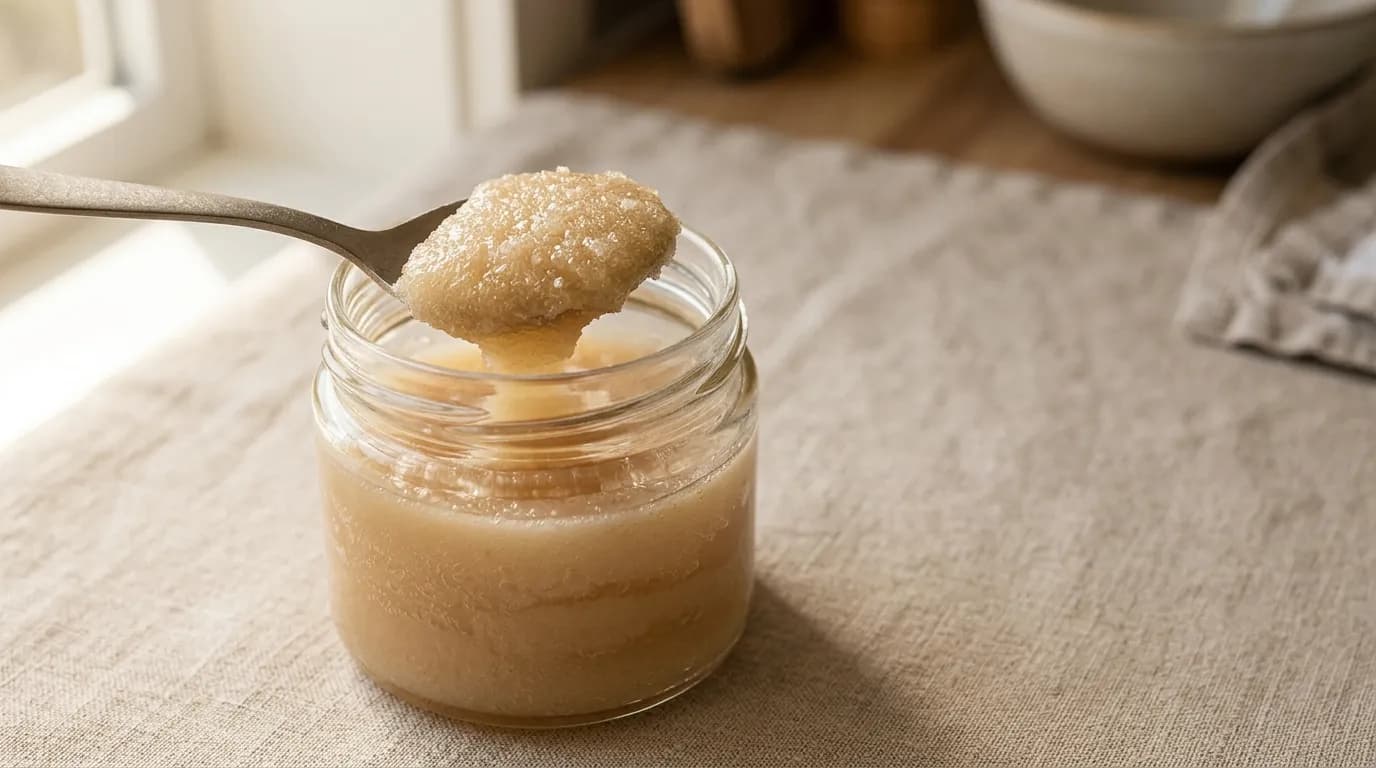
Crystallized Honey: Why Real Honey Turns Solid
Thousands of people every month look for a way to undo the one thing that tells them their honey is doing what honey does. Here is what crystallization actually is.
Good to Know
How to Tell Good Honey from Industrial Blends: 5 Signs That Matter
Most honeys in the supermarket look identical: golden yellow, liquid, mild. What the label does not tell you: where the honey actually comes from and how it was processed.
Good to Know
Manuka alternative: sainfoin honey compared with buckwheat, sidr and jarrah
White sainfoin honey from the Tian Shan costs €6.98 per 100 g, Manuka MGO 250+ to 550+ in our examples €9.56 to €25.68. Five honeys side by side, every number sourced, the limits of each one stated.
From the Hive
Honey knowledge the supermarket skips
Twice a month: varietals, harvest, origin. Plus 10% off your first order.
10% off your first order · No spam. Unsubscribe anytime.