
Good to Know
Strawberry Honey: Why Honey and Dried Strawberry Work
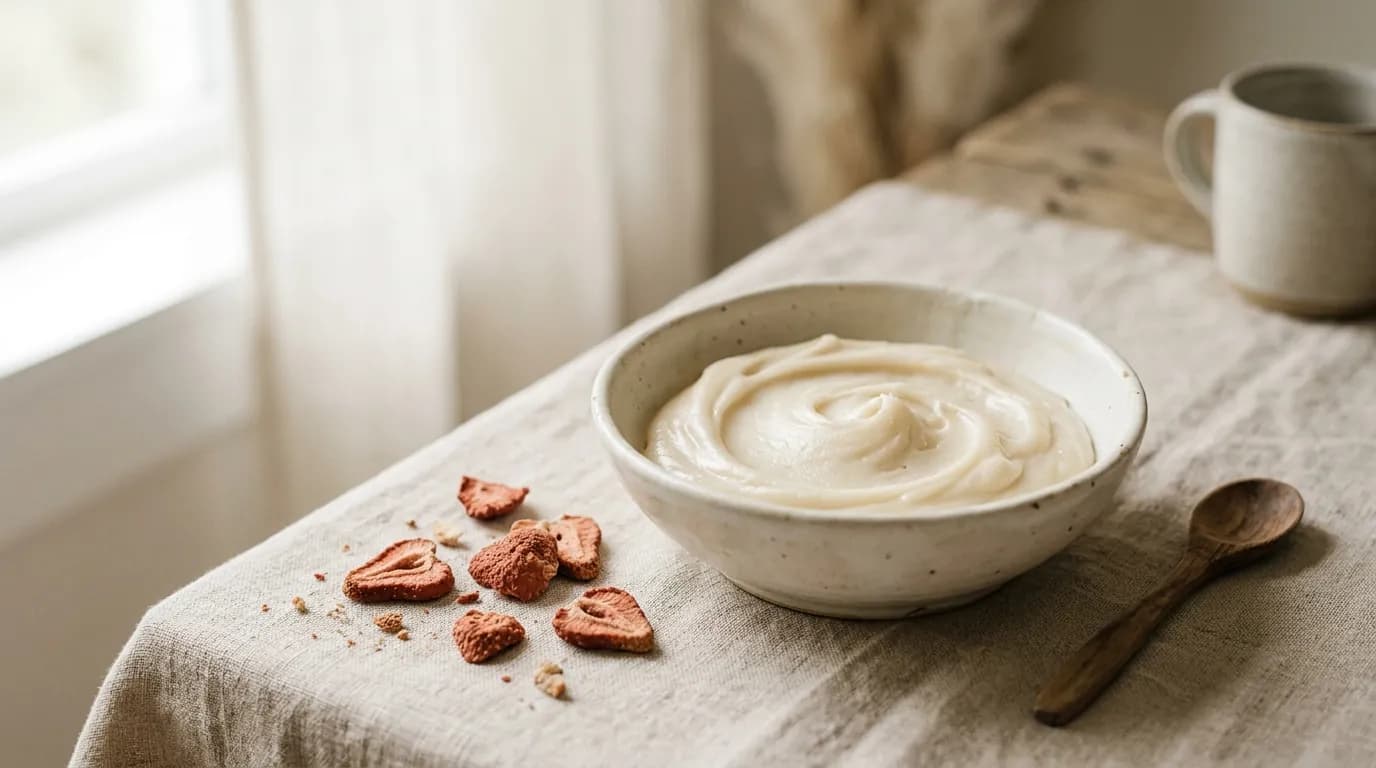
Real strawberry honey has two ingredients. Creamed honey and dried strawberry. Whatever else appears on the ingredient list pushes the jar towards jam, and it usually appears in this order: sugar, jam sugar, colouring, flavour concentrate, preservative. This is not a matter of taste. Honey needs no gelling agent because it does not gel at all, it crystallises, and that is exactly why a preparation of honey and dried fruit holds together without the props a jam depends on.
What is strawberry honey, and why is it called something else on the label?
People search for the words strawberry honey. On the label, those words are usually not allowed.
The reason sits in the EU Honey Directive, which defines what honey is and which ingredients it tolerates. Honey is the product of bees, with nothing removed and nothing added. Put a second ingredient in and the result is legally no longer honey, even when it is over ninety percent honey. The usual name becomes honey preparation with strawberry.
That sounds like pedantry and is in fact the most useful line on the whole jar. If the name is not allowed to say honey, the ingredient list has to say all the more precisely what is inside. Under the EU Food Information Regulation every ingredient appears there in descending order of weight, and any ingredient named in the product name carries its percentage as well. Two lines of ingredient list mean two ingredients. Seven lines mean seven.
Why does dried strawberry belong in honey at all?
Honey is a supersaturated sugar solution holding very little water. The EU Honey Directive draws a line for water content. Honey may not hold more than 20 percent water, and the German quality standard sets the bar at 18 percent. That dryness is where honey gets its keeping quality. There is simply too little water for much to happen.
Fresh strawberries are almost entirely water. Stir them into honey and you raise the water content, which removes the very property that keeps the mixture stable. After that you need heat, added sugar or preservatives to stop the contents from fermenting. What you have then is no longer honey with fruit. It is jam with some honey in it.
Dried strawberry skips that detour. It carries colour, acidity and aroma in concentrated form, without pushing water back in.
The colour turns out differently from what most people expect. Dried fruit is not a signal red. In pale creamed honey it stays pale, a restrained pink. People who do not know this read it as a fault. The opposite is true: a jar of bright red almost always gets that colour from a colouring or a concentrate rather than from the strawberry.
There is a second, less obvious point: the texture of the honey itself. Runny honey carries no fruit pieces. They float up or sink, and in the end everything sits in one layer. Creamed honey can do it. Its fine crystallisation is dense enough to hold the pieces where they were at filling. Creamed honey is made by controlled crystallisation and stirring, not by additives. How that works in detail is in our guide to white honey.
From the Hive
Honey knowledge the supermarket skips
Twice a month: varietals, harvest, origin. Plus 10% off your first order.
10% off your first order · No spam. Unsubscribe anytime.
How is this different from strawberry jam or a fruit spread?
Three products that sit side by side on the shelf and have little in common technically.
| Jam / preserve | No-added-sugar fruit spread | Honey preparation with strawberry | |
|---|---|---|---|
| Sweetness comes from | added sugar | fruit juice concentrate or sweetener | honey and fruit themselves |
| Gelling agent | jam sugar, pectin | pectin | none |
| Production | cooked | cooked | stirred, not boiled down |
| Keeps because of | sugar content and heating | heating, often a preservative | low water content |
| Ingredient count | several | several | 2 |
The difference you read is the number of ingredients.
How do you tell from the label that there is still honey in there?
Five things, in this order. All of them are on every jar sold in the EU.
1. The length of the ingredient list. Two entries, honey first, fruit with a percentage. Anything beyond that is not automatically bad, but it does need explaining.
2. No sugar, no jam sugar. Jam sugar is mostly sugar plus a gelling agent. It is never there because the product needs it, only because a watery recipe needs it. If it shows up, water was involved.
3. No colouring. Dried strawberry gives a paler tone than fresh. Anyone seeing a bright red in the jar is usually not looking at fruit. Colourings are additives and have to appear as such in the ingredient list, often with an E number.
4. No flavour concentrate. A concentrate replaces quantity of fruit with intensity of taste. It is cheaper and it shouts louder. It is also the point where a food turns into a formulation.
5. No preservative. It is an admission that the water content is too high. A preparation of honey and dried fruit manages without one, because there is not enough moisture for anything to take hold.
Then there is the line that is always there and always skipped: the country of origin of the honey. For blends it now has to be spelled out, country by country, instead of hiding behind a collective phrase. A single origin is easier to spot than it used to be. It is worth a look. The back of the jar says more than the entire front.
What we are preparing
We are working on a honey preparation with strawberry, built on our creamed sainfoin honey. The standard is set before the product is: honey and dried strawberry, nothing else. No sugar, no jam sugar, no colouring, no flavour concentrate, no preservative.
That is all we are saying today. No price, no jar size, no date. What we can say about the honey underneath is in our piece on sainfoin honey.
How do you store a jar like this?
Cool, dry, dark, at a storage temperature of no more than 20 °C. For creamed honey that line is an edge rather than a guideline. Above it the fine crystallisation coarsens or melts, the honey separates, and no amount of stirring brings the original texture back. Too cold is no better, since the mass then goes hard and barely spreads. The long version is in storing honey and understanding crystallisation.
The fruit changes none of that. It follows the honey it hangs in.
The actual test
Turn the jar around and count the lines. Two ingredients are a decision somebody made, and it costs more than the alternative. Seven ingredients are a decision too.
Share
Frequently Asked Questions
Under the EU Honey Directive only pure honey with no second ingredient may be sold as honey. Add a second ingredient and the jar needs a different legal name, usually something like honey preparation with strawberry. The contents stay the same, the wording on the label changes.
Fresh fruit is mostly water. Honey is a supersaturated sugar solution holding very little water, under 20 percent by EU rule. Add water and you shift that balance, and then you need heat, sugar or preservatives. Dried fruit brings colour and aroma without moving the ratio.
That is decided by the recipe, not by the category. Honey and dried fruit bring their own sugar, and a clean recipe adds none. Whether a particular jar contains sugar or jam sugar is written in the ingredient list.
A fruit spread is cooked and needs a gelling agent, usually pectin, often with fruit juice concentrate for sweetness. A honey preparation does not gel at all. It stays spreadable because creamed honey is finely crystallised.
Cool, dry and dark, at a storage temperature of no more than 20 °C. Above that line the fine crystallisation of creamed honey coarsens, and that cannot be undone.
Not yet. We are preparing a honey preparation with strawberry, and the standard is fixed: honey and dried strawberry, nothing else. We will name a date once we have one.

ULU Redaktion
Redaktion
Das ULU Team recherchiert und schreibt zu Honig, Herkunft und bewusstem Genuss.
Related Articles

The Makers
What Is Sainfoin Honey? The Complete Guide to a Rare Honey
Some honeys you find in every supermarket. Then there is sainfoin honey.
The Makers
White honey: what it is, where it comes from and where to buy it
White honey is honey whose glucose has crystallised into very fine crystals. The crystals reflect light, which is why it looks creamy white. Which varieties do this, where they come from and how to recognise good white honey.
Good to Know
Manuka alternative: sainfoin honey compared with buckwheat, sidr and jarrah
White sainfoin honey from the Tian Shan costs €6.98 per 100 g, Manuka MGO 250+ to 550+ in our examples €9.56 to €25.68. Five honeys side by side, every number sourced, the limits of each one stated.
From the Hive
Honey knowledge the supermarket skips
Twice a month: varietals, harvest, origin. Plus 10% off your first order.
10% off your first order · No spam. Unsubscribe anytime.